
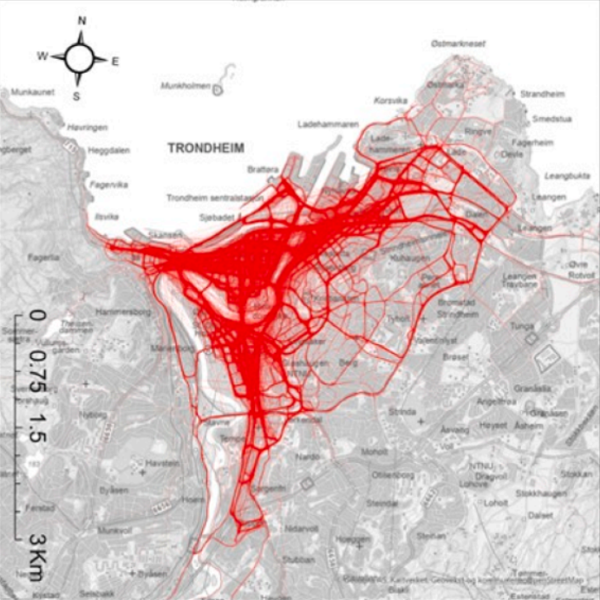
This research delves into the nuanced behaviors of city-bike users in Trondheim, Norway, revealing how infrastructure and environmental factors influence cycling patterns. By distinguishing between user types, it highlights the importance of tailored urban planning to enhance bike-sharing systems’ efficiency and inclusivity.
Decoding City-Bike User Dynamics
In the quest for sustainable urban mobility, cycling has emerged as a pivotal alternative to motorized transport. City-bike systems, integral to this shift, offer both transport and leisure opportunities. However, the effectiveness of these systems hinges on understanding the diverse behaviors of their users. This research addresses a significant gap in existing studies, which often treat city-bike users as a homogeneous group. By doing so, it overlooks the distinct needs and behaviors of different user types, from frequent commuters to occasional leisure riders.
The study focuses on Trondheim’s bike-sharing network, aiming to uncover how various users interact with the city’s geography and infrastructure. Existing literature has explored cycling behaviors mainly through the lens of general cyclists, using methods like surveys and GPS tracking. However, these studies typically do not differentiate between the unique behaviors of bike-share users. This oversight is crucial, as bike-share systems serve both utilitarian and leisure purposes, each with distinct spatial activity patterns.
Recognizing this diversity is essential for developing effective urban transport policies. Without it, interventions risk being optimized for an abstract “average cyclist,” potentially neglecting the specific needs of both regular and occasional riders. The research aims to fill this gap by investigating how different user groups interact with cycling infrastructure, providing insights that are directly relevant for urban planning and policy.
Methodology: Classifying City-Bike Users
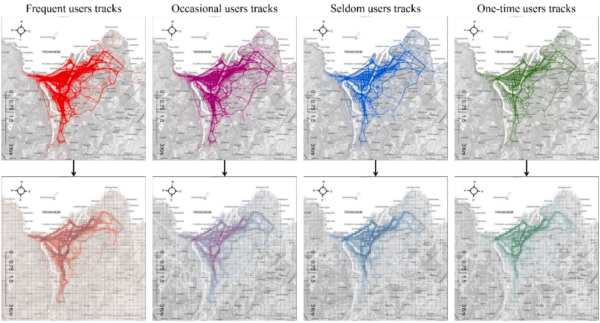
The research employs a comprehensive dataset from Trondheim’s city-bike system, which records detailed trip information while preserving user anonymity. This dataset allows the classification of users into four categories: frequent, occasional, seldom, and one-time users. This classification reflects differences in travel motivation and intensity, with frequent and occasional users likely representing regular, utilitarian cyclists, while seldom and one-time users indicate leisure-oriented or tourist use.
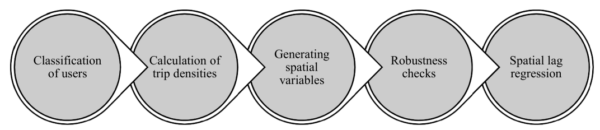
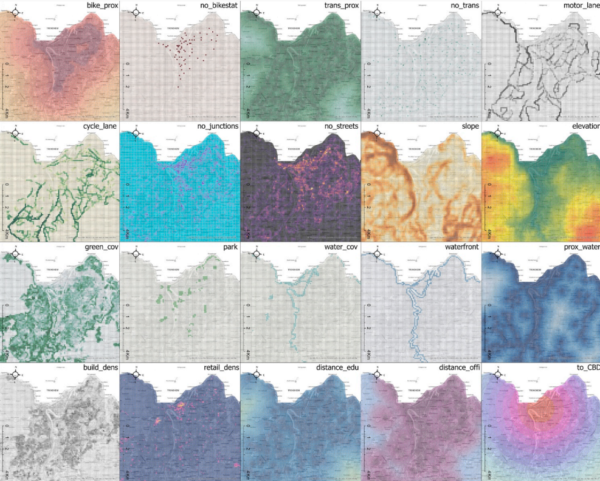
By integrating route data with measures of accessibility, connectivity, environment, and land use, the study identifies distinct spatial dependencies that reflect different relationships between cyclists and the urban landscape. The methodology involves spatial regression analysis to assess how these factors influence cycling behavior across different user types.
This approach not only advances empirical knowledge but also provides a replicable framework for extracting user-related insights from anonymized data, common in shared mobility systems. By explicitly accounting for user heterogeneity, the study offers a nuanced understanding of spatial and environmental determinants of route choice, moving beyond economic motivations to include urban form and ecological context.
Findings: Influences on Cycling Behavior
The analysis reveals that terrain significantly deters cycling and reshapes how riders depend on infrastructure. Regular users are primarily influenced by network connectivity and station accessibility, underscoring the importance of infrastructural density in overcoming spatial barriers. In contrast, casual and leisure users respond more to the experiential qualities of place, such as cycle lanes, retail destinations, and scenic waterfronts.
These findings demonstrate that city-bike use cannot be understood through uniform design principles. Instead, it emerges from multiple geographies of dependence, where infrastructural function, environmental experience, and topography jointly shape cycling behavior. Recognizing these differentiated patterns is crucial for building bike-share systems that are efficient, accessible, and inclusive across diverse urban settings.
Implications for Urban Planning
By highlighting the diverse needs of city-bike users, this research provides valuable insights for urban planners and policymakers. Understanding where and under what conditions different user groups cycle can inform more nuanced infrastructure provision, station placement, and integration with public transport. Such targeted approaches may support the commuting needs of regular riders while promoting cycling as a leisure activity, broadening the appeal and functionality of bicycle-sharing systems.
We thank the authors for their valuable contribution to the field of urban mobility. For those interested in further discussion or collaboration, the research offers a solid foundation for developing data-driven strategies that genuinely support mode shift, equity in access, and long-term sustainability.
Reference: M. Tsaqif Wismadi, Yngve K. Frøyen, Thomas A.S. Nielsen, Adil Rasheed, Christoffer B. Åkre. “Uneven geographies of cycling: How infrastructure and environment shape the behaviours of experienced and casual city-bike users.” Journal of Urban Mobility 9 (2026) 100205. DOI: https://doi.org/10.1016/j.urbmob.2026.100205