
This research examines the European Union AI Act, revealing its environmental shortcomings and proposing pathways for integrating sustainability into AI regulation. It highlights the Act’s limitations and suggests reforms for a more environmentally conscious AI future.
The AI Act’s Environmental Oversight
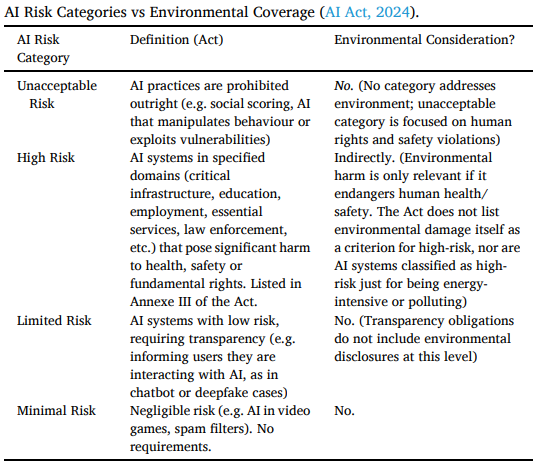
The European Union’s Artificial Intelligence (AI) Act is a comprehensive regulatory framework for AI technologies. However, it faces criticism for not directly addressing environmental considerations. While AI can address environmental challenges, the Act does not explicitly categorize environmental impacts as standalone risks. Instead, these concerns are indirectly addressed through procedural mechanisms like transparency and governance requirements.
This oversight raises questions about the AI Act’s alignment with the EU’s broader environmental commitments, such as the European Green Deal. The Act’s human-centric approach, which frames environmental issues primarily in terms of their impact on people, rather than recognizing the environment’s intrinsic value, is seen as a critical weakness. This anthropocentric perspective contrasts with an ecocentric approach, which would prioritize environmental impacts as primary regulatory concerns.
The research identifies an “instrumentation gap” between the EU’s constitutional commitment to environmental protection and the modest, often voluntary, environment-related obligations scattered throughout the Act. This gap underscores a governance problem where sustainability is acknowledged as an objective but is not operationalized within the Act’s risk framework. As the EU aims for climate neutrality by 2050, the need for robust environmental integration into AI regulation becomes increasingly urgent.
Research Approach and Proposed Solutions
The research employs a doctrinal and operational analysis to scrutinize the AI Act, coding environment-relevant provisions across its Articles and Annexes. By applying regulatory instrumentation theory, the study examines how sustainability objectives are not directly translated into binding obligations. The methodology involves a comprehensive codebook that maps environmental significance, legal force, lifecycle stage, and measurability across the Act’s components.
The authors propose an operational reform pathway that integrates Life Cycle Assessment (LCA) and post-market monitoring into the existing framework. This approach aims to enhance environmental sustainability without altering the Act’s risk classification. The research suggests adopting shared standards and collaborative governance mechanisms to bridge the gap between environmental aspirations and practical implementation.
The study highlights the limitations of the current compliance mechanisms, which rely heavily on voluntary standards and future standardization processes. By identifying concrete provisions that enable LCA integration, the research clarifies the possibilities and limits of embedding environmental sustainability within the EU’s AI regulation.
Findings and Insights
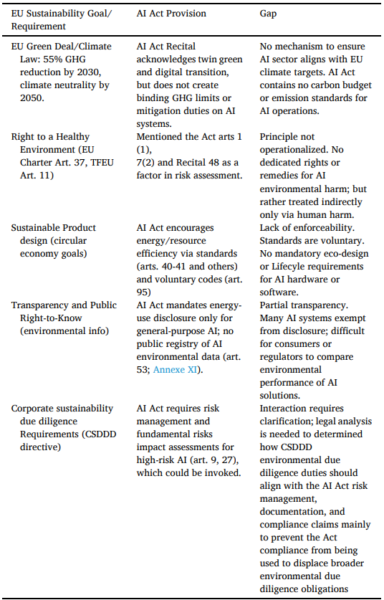
The research reveals that while the AI Act acknowledges environmental protection as an objective, it primarily offers indirect or voluntary measures rather than binding environmental obligations. This creates a tension between the EU’s sustainability commitments and the Act’s human-centered focus. The study emphasizes that the Act should not be viewed as a failure or a success but as an evolving framework that requires further integration of sustainability principles.
By coding environment-relevant provisions, the authors demonstrate how environmental considerations are integrated into binding compliance requirements, where they remain vague, and how the Act produces an “instrumentation gap.” This gap highlights the difference between the Act’s environmental aspirations and the operative tools through which it allocates obligations.
Path Forward for Sustainable AI Regulation
The research underscores the need for a more robust integration of environmental sustainability into the AI Act, advocating for the operationalization of Life Cycle Assessment and the adoption of co-regulation and collaborative governance mechanisms. These reforms could enhance the legitimacy and effectiveness of the EU’s AI regulation, aligning it more closely with the Union’s environmental goals.
As AI continues to evolve, this study serves as a call to action for policymakers, industry stakeholders, and civil society to collaborate on developing a regulatory framework that prioritizes environmental sustainability. The authors invite further dialogue and input from those interested in advancing this critical area of research.
Reference: Imad Antoine Ibrahim, Esmat Zaidan, Jon Truby, Thomas Hoppe. “The AI Act and its green blind spots: Hidden environmental risks in the AI lifecycle.” Technology in Society 86 (2026) 103284. DOI: https://doi.org/10.1016/j.techsoc.2026.103284