
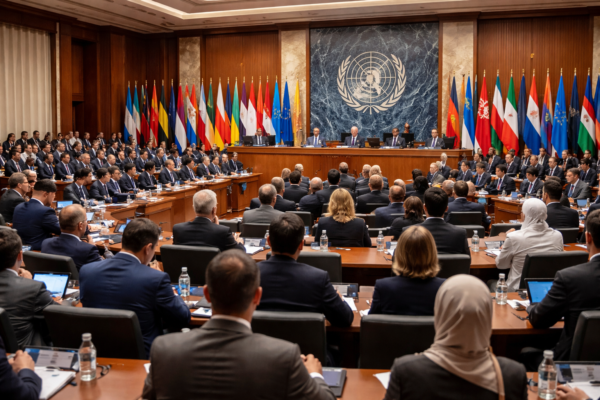
In a world increasingly shaped by Artificial Intelligence, this research delves into the strategic and legal dimensions of AI diplomacy, exploring how nations navigate the AI race. It highlights the potential for AI to foster international cooperation, despite intensifying global competition.
The AI Race: A New Cold War?
The rapid advancement of Artificial Intelligence (AI) technologies has ushered in a new era of international relations, reminiscent of the Cold War’s nuclear arms race. This research identifies the emergence of AI as a pivotal domain of great-power competition, with nations vying for technological supremacy. The stakes are high, as AI is not only a strategic industrial asset but also a significant tool in international trade negotiations. The dual nature of AI, as both a potential weapon and a driver of economic growth, has elevated it to the forefront of diplomatic agendas worldwide.
AI’s influence extends beyond traditional statecraft, impacting governance, policy, and global security. The race to harness AI’s capabilities has intensified, with major actors like the United States, China, and the European Union adopting diverse strategies to gain an edge. These strategies range from techno-nationalism to regulatory diplomacy, each reflecting the unique political and economic contexts of these regions. The challenge lies in balancing the economic opportunities AI presents with the inherent risks it poses, including its potential use in warfare, surveillance, and cyber operations.
Exploring AI Diplomacy
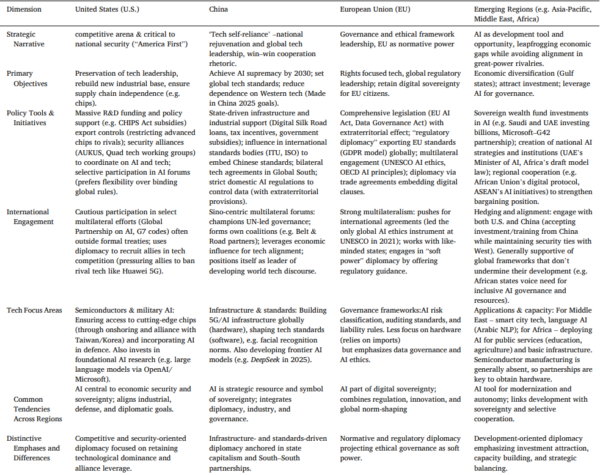
The study employs a qualitative, comparative approach to analyze the AI strategies of major global players, including the United States, China, and the European Union. By examining these strategies, the research aims to refine the concept of ‘Tech Diplomacy’ and introduce ‘AI Diplomacy’ as a distinct framework. This framework encompasses the diplomatic efforts related to AI development and control, including hardware acquisition, standard setting, and knowledge sharing.
The researchers explore how AI Diplomacy differs from previous technological advancements, such as nuclear and internet diplomacy. Unlike the nuclear regime, AI lacks clear material boundaries and centralized governance, complicating traditional state-to-state negotiations. The study highlights AI’s hybrid nature, operating across security, economic, and normative domains, and involving not only states but also corporations and multilateral organizations.
By comparing regional approaches to AI Diplomacy, the research identifies distinct pathways through which states convert technological capability into diplomatic influence. The United States’ security-oriented techno-nationalism, China’s infrastructure-driven state capitalism, and the EU’s normative and regulatory diplomacy each represent unique responses to the global AI race.
Strategic Insights and Conclusions
The research concludes that AI Diplomacy is a novel and evolving perspective on international relations. It underscores the strategic importance of AI considerations in shaping global politics and highlights the potential for AI to serve as a tool for international stability and improved relations. The study reveals how AI Diplomacy builds upon and departs from earlier forms of technological diplomacy, offering a framework for understanding the interaction between domestic governance models and external diplomatic behavior in the AI domain.
The comparative analysis of regional approaches demonstrates how different political economies have developed distinct logics of AI Diplomacy. The study provides an analytical framework that uncovers the structural relationship between domestic governance and international engagement in the AI field.
Future Directions and Global Implications
This research offers valuable insights into the evolving landscape of AI Diplomacy, emphasizing its potential to foster international cooperation amidst intensifying global competition. As AI continues to reshape international relations, the study calls for further exploration of AI’s role in diplomacy and its implications for global governance. The authors invite policymakers, researchers, and stakeholders to engage with these findings and contribute to the ongoing discourse on AI Diplomacy.
Reference: Truby, J., Dahdal, A., Brown, R., & Ibrahim, I. (2026). Diplomacy in the age of AI: Legal and strategic approaches to techno-nationalism, regulatory soft power and the AI chips race. Research in Globalization, 12, 100335. DOI: https://doi.org/10.1016/j.resglo.2026.100335