
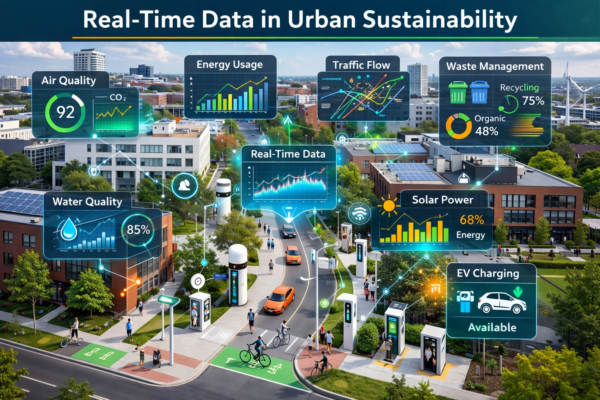
This editorial explores the role of distributed sensors and real-time data in improving urban management, addressing sustainability issues through proactive strategies, digital twins, and inclusive frameworks, drawing on worldwide experiences to inform better decision-making and equitable outcomes.
Urban Challenges: The Need for Better Environmental Data Integration
Cities are confronting growing pressures from climate change, air pollution, urbanization, and resource constraints, requiring integrated approaches across natural, human, social, built, and financial capitals. The editorial points out that real-time environmental data from distributed sensors holds significant potential, but the dispersed nature of these issues often hinders the creation of compelling business cases. Consequently, many cities rely on limited data for decisions, with processes not optimized for the detail and timeliness of real-time information.
This is important because urban governance depends on holistic solutions. Real-time data can advance aims such as public health improvements, zero-carbon transitions, and net environmental gains, while supporting infrastructure decisions amid climate risks and demographic changes. Referencing Sustainable Development Goal 17, the editorial identifies data, monitoring, and accountability as key enablers for sustainability.
However, insights from 15 years of smart city efforts highlight drawbacks. Top-down methods often ignore local needs, resulting in ineffective solutions and reliance on external tech providers. These can deepen inequalities, for instance, sensors are typically placed in affluent areas, forming “sensor deserts” in disadvantaged zones. This conceals problems like higher air pollution in low-income areas and misallocates resources, as observed in UK cities.
The editorial advocates for inclusive governance to prevent real-time data from worsening disparities. Municipalities contend with budget limits, political dynamics, and capacity shortfalls in IoT deployment. Decision cycles misalign with data potential, necessitating co-design with stakeholders. Frameworks like living labs and urban observatories facilitate integration among data providers, analysts, regulators, and citizens. Still, gaps in technology, skills, and urban system knowledge mean real-time environmental data infrequently influences policy or planning, despite merging smart and sustainable city discussions.
Research Method: Compiling Worldwide Case Studies in a Thematic Collection
This editorial presents a Research Topic that compiles experiences from cities worldwide on using real-time environmental data for decision-making. It examines how digital technologies enable new governance, politics, and planning by emphasizing data monitoring, while evaluating technical, social, economic, and political constraints. Contributions are categorized into four themes: using data (societal and scientific barriers, applications from intervention monitoring to policy evaluation, and data usability strategies for practitioners, citizens, policymakers, and researchers); enabling the new (advanced processing like AI, innovation networks, digital twin-based governance for simulations, and experimental or collaborative models); tackling practical monitoring challenges (sensor integration in infrastructure, organizational skills and structures, and network longevity); and managing data (access and distribution strategies in smart frameworks, intermediary roles like urban observatories, and impacts of sharing via portals, APIs, and tools for diverse audiences including public, industry, government, and academia).
The collection comprises eight papers, several from UK Urban Observatories—platforms aligning IoT sensors with municipal requirements. James et al. describe the Newcastle Urban Observatory, covering socio-technical challenges in sustaining sensor networks responsive to decision-makers, including practical, technical, and political elements. Bannan et al. outline the Manchester Urban Observatory’s cross-disciplinary method, combining atmospheric data, public activity measures, and wellbeing assessments to link urban design, mobility, air quality, and health.
Rogers et al. detail a city council collaboration using systems mapping, assessment tools, and futures analyses for governance. Regarding governance changes, Coraggio et al. from the Bristol Urban Observatory assess water quality sampling rates (e.g., temperature, dissolved oxygen) in the Floating Harbor, showing how IoT resolutions meet regulatory variations. Shrimpton et al. discuss the Pipebots project, using miniature robots for pipe data in water systems, requiring shifts from reactive to predictive utility practices. Goulas et al. examine public perceptions of IoT smart water meters, noting how views affect adoption and data representativeness, with citizen-data implications.
Truong et al. develop a socio-technical framework connecting urban systems to consumption, demonstrating real-time data’s role in system interactions. Topping et al. address air quality data and digital twin needs, calling for inclusive governance to support co-creation and sharing.
This interdisciplinary approach, spanning data science to civil engineering, provides practical guidance on operationalizing environmental data for governance.
Essential Findings: Outcomes from the Studies
The papers indicate that real-time data offers benefits such as multi-year high-resolution datasets for AI analyses, immediate analytics for decision support, vulnerability identification for preventive maintenance, digital twin configurations for simulations, and multi-scale event reviews. Challenges include investment obstacles, incompatible decision processes, and needs for cross-disciplinary expertise in environmental science, transport, engineering, and public health.
Thematic findings show sensors provide broad coverage, but co-creation is essential to avoid inequality amplification. Urban Observatories support deployment, maintenance, and integrated insights, e.g., connecting planning to wellbeing through data. Higher sampling addresses regulatory shortcomings, while technologies like Pipebots demand proactive norms. Perceptions influence technology adoption, affecting data quality. Socio-technical models expose system dynamics, and digital twins require collaborative frameworks.
The editorial states that the concept of “smart” is only “truly smart” if it helps to deliver on the sustainability, resilience and livability agendas, with data designed responsive to local needs.
Outlook: Advancing Governance Through Data Innovation
As digital twins progress and decarbonization needs intensify, combining real-time data with adaptive governance offers opportunities for resilient, inclusive urban development. We thank James Evans, Maria Pregnolato, Christopher D. F. Rogers, Jim A. Harris, and David Topping for this editorial. If you have insights on urban data applications or policy integration, contact us to discuss potential features.
For the full details, see: Evans, J., Pregnolato, M., Rogers, C. D. F., Harris, J. A., & Topping, D. (2023). Editorial: Environmental data, governance and the sustainable city. Frontiers in Sustainable Cities, 5, Article 1355645. https://doi.org/10.3389/frsc.2023.1355645