
A study estimates the effects of Tradable Mobility Credits on Europe’s long-distance leisure travel, where emissions are capped by design and prices emerge from market equilibrium, resulting in a 20% demand reduction, air share dropping from 50% to 42%, and rail increasing from 23% to 32% under a 30% emission target.
Emissions Challenge in Long-Distance Travel
Long-distance travel, trips over 100 km, contributes significantly to Europe’s greenhouse gas emissions. These journeys represent about 2.5% of all trips but account for around 55% of passenger-kilometers, generating roughly 16% of transport-related emissions. In 2019, transport produced 29% of the EU’s total emissions, highlighting the need for reductions to meet Paris Agreement goals. Leisure travel predominates, with air, rail, and car as main modes; air emits 6 to 8 times more CO2 per passenger-kilometer than rail, while car emissions vary by distance and efficiency.
Aviation taxes have limitations: they are nationally varied, leading to under-taxation and distortions, and do not cap emissions directly or ensure equity. The EU Emissions Trading System allows excess emissions via allowances not fully passed to consumers. Demand management strategies, such as modal shifts from air to rail, are identified as key for reductions.
Tradable Mobility Credits fix emission caps with prices determined by traveler choices, differing from taxes. Credits are allocated equally and for free, potentially improving acceptance as surplus holders can sell them without government revenue. Prior research on TMC focused on urban contexts, leaving long-distance applications unexplored despite their relevance and enforcement advantages.
This is important for policy. With over 307 million annual leisure trips in Europe, unmanaged emissions hinder climate targets. TMC may encourage shifts to lower-emission modes and reduce demand, supporting decarbonization alongside technological improvements.
Modeling Approach for TMC Simulation
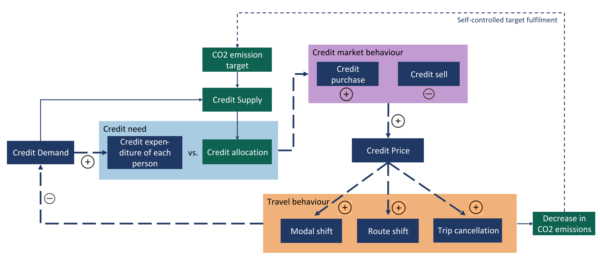
The study develops a market equilibrium model to assess TMC impacts on long-distance leisure travel in Europe, linking travel choices (mode, route, cancellation) with credit trading. A pan-European authority allocates credits equally and for free, scaled to a 30% emission reduction based on the EU’s 2030 Climate Target Plan (linear from 2019). Credits reflect trip CO2 emissions, are traded centrally, and apply to leisure trips to target individual cost perceptions.
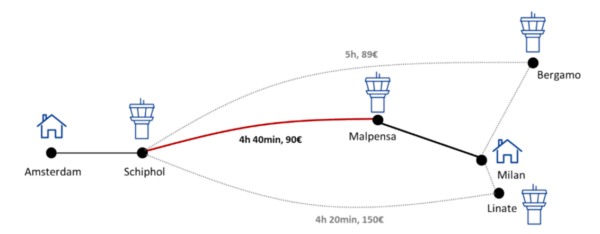
Transport specifications cover air, rail, and car. Travel times include access/egress (20 minutes fixed for rail, variable for airports), in-vehicle times from platforms like kiwi.com and trainline.com. Costs include tickets (lowest generalized cost for rail), fuel (by country), and tolls at 0.06€/km. Emissions use Milieu Centraal data: air varies by distance (0.138 kg CO2/pkm for ≤400 km to 0.101 for ≥1,000 km), rail 0.017 with 1.3 detour factor, car 0.107 with 1.9 occupancy, 7L/100km, 1.2 detour factor. Airports are selected to minimize generalized costs.
Demand includes 73 metropolitan areas, 307 million trips across 2,998 OD pairs. Utilities incorporate travel time (country-averaged 11.82€/hour for leisure), costs, and credit expenses (price × distance × emissions). A Logit model calculates modal shares; cancellations use -0.6 price elasticity. Income elasticity (1.4) varies credit needs by country.
Credit dynamics iterate: supply scales emissions by target; imbalances adjust prices until equilibrium (<1% change). Python with pandas implements the model, running in minutes. Sensitivities test elasticities (-0.35 to -1.1) and 2030 scenarios (medium: 25% electric cars, 5% sustainable aviation fuels; high: 50%, 15%). This approach applies TMC to long-distance travel, capturing interactions not addressed in urban studies.
Main Results and Findings
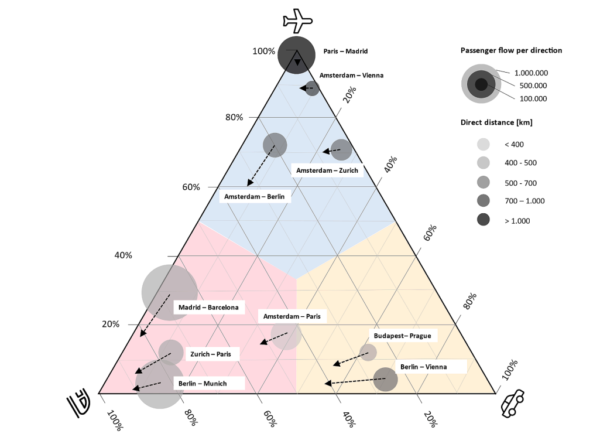
Equilibrium produces a 272€ per ton CO2 credit price for 30% reduction. Demand decreases 20% (61 million cancellations), with remaining trips shifting: air from 50% to 42%, rail from 23% to 32%, car from 27% to 26%, a net air decrease of 8%, rail increase of 9%, car decrease of 1%. Including cancellations: air 34%, rail 26%, car 20%. Shifts are strongest at 500-800 km (rail +10 points), influenced by competition; longer routes see higher cancellations.
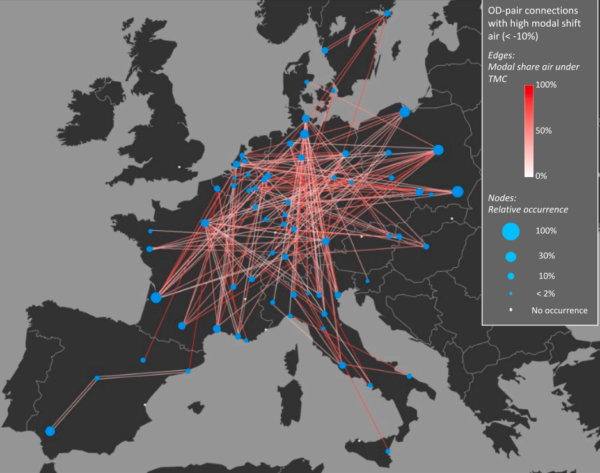
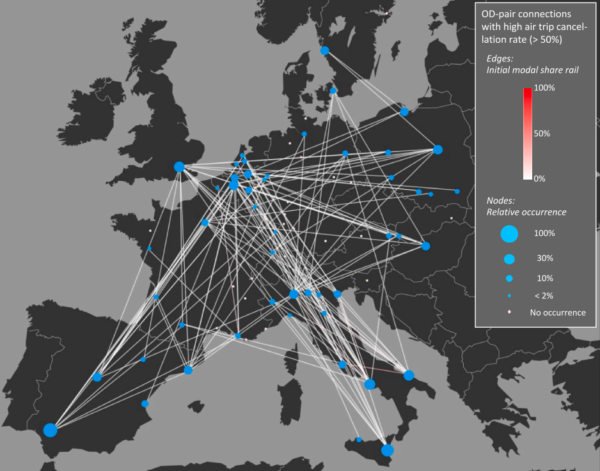
Geographically, central-eastern Europe shows notable air-to-rail shifts due to lower value of time; peripheral areas (e.g., Southern Italy) have >50% cancellations on 4% of OD pairs from limited rail and low-cost flights. Credit costs are lowest for rail, comparable for air and car but higher for long car trips.
Sensitivity indicates credit prices from 424€ (-0.35 elasticity, greater modal shifts) to 159€ (-1.1, greater cancellations). Technological progress reduces impacts: medium scenario gives 235€ price, air 36%, cancellations 16%; high gives 164€, air 41%, cancellations 10%.
The study finds TMC achieves caps, with variations based on local value of time and competition.
Outlook and Potential Developments
Future work could incorporate buses, business travel, or non-CO2 effects, and extend perimeters to avoid emission displacement. Investments in rail supply may enhance shifts and welfare.
We thank Sandro Tanner, Jesper Provoost, and Oded Cats for this contribution to transport policy. Share insights on TMC or related topics; connect via comments or contact the authors. “Our findings contribute to the on-going debate surrounding instruments for stimulating sustainable (im)mobility, in particular in the context of the long-distance travel market.”
For details, see: Tanner, S., Provoost, J., Cats, O., 2024. Tradable mobility credits for long-distance travel in Europe. Transportation Research Part A: Policy and Practice 186, 104156. https://doi.org/10.1016/j.tra.2024.104156.