
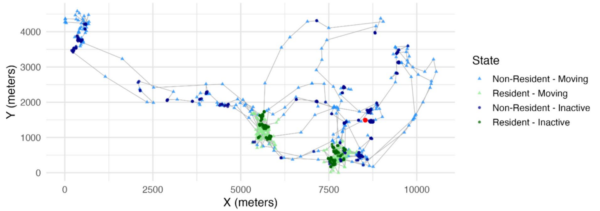
This research presents a hidden Markov model framework that identifies animal activity modes and movement phases, offering a nuanced approach to ecological inference and wildlife conservation. By integrating both scales of movement, it provides insights into animal behavior and strategies for effective conservation management.
Understanding the Movement Puzzle
Understanding animal movement is crucial for studying ecological processes such as space use, habitat selection, and connectivity. These processes are fundamental to animal ecology, influencing fitness, survival, and population dynamics. As such, they are essential for effective conservation and management of wildlife populations. However, identifying the components of movement paths poses a significant challenge. Most existing methods do not account for how fine-scale behaviors depend on broader movement phases, thus limiting the ecological insights that can be drawn from movement data.
With advances in biologging technologies, researchers can now collect animal tracking data at fine spatial and temporal resolutions, providing an opportunity to analyze how and why animals move through their landscapes. Despite this, segmenting animal tracks into biologically meaningful units remains a complex task. Traditional methods often focus on either fine-scale activity modes or broad-scale movement phases, without fully integrating the two. This separation overlooks the interconnectedness of these dimensions, as short-term behavioral decisions frequently depend on the larger ecological context.
To address these challenges, the research introduces a hidden Markov model (HMM) framework that jointly analyzes fine-scale activity modes (inactive, moving) and broader movement phases (resident, non-resident). This approach aims to provide a flexible and accessible method for segmenting movement trajectories into behaviorally meaningful states, ultimately enhancing our understanding of animal movement strategies.
Innovative Methodology
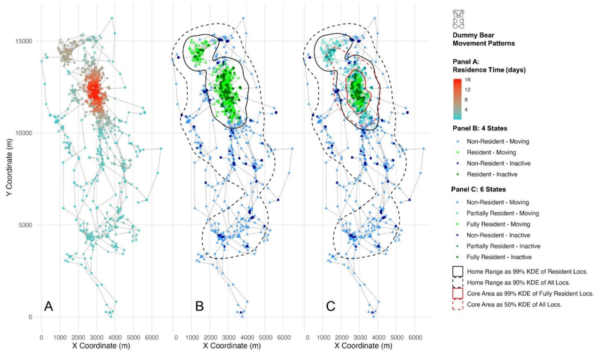
The researchers developed an asymmetric coupled hidden Markov model (ACHMM) structure to analyze animal movement data. This model uses variables directly derived from GPS tracks—specifically step lengths and turning angles—to identify activity modes, while residence time is used to characterize broader movement phases. The ACHMM allows activity modes to depend on movement phases, but not vice versa, capturing the hierarchical nature of animal movement.
The framework was demonstrated using telemetry data from Cantabrian brown bears, a species known for diverse movement strategies. The researchers modeled state transition probabilities as functions of bear identity and time of day, employing splines to examine interindividual variation in diel activity. This approach allowed for the integration of ecological inference across movement scales, providing a comprehensive view of how environmental factors shape animal behaviors and movement strategies.
To implement the model, the researchers used the hmmTMB R package, which offers tools for incorporating covariates to model transition probabilities and account for interindividual heterogeneity. The ACHMM was designed as a 4-state model, jointly modeling two fine-scale activity modes and two broad-scale movement phases, allowing for a nuanced understanding of animal movement dynamics.
Insights and Conclusions
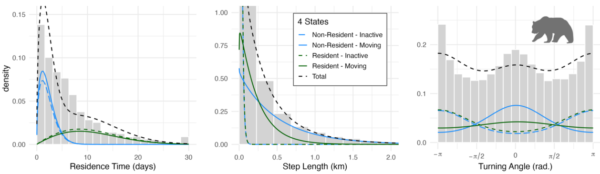
The ACHMM effectively segmented animal trajectories into interpretable states, such as residence areas, stepping-stones, dispersals, and excursions. This segmentation provided a biologically informed approach to identifying home ranges and core areas. The model also revealed that the characteristics of activity modes vary with movement phases, highlighting interindividual differences and phase-dependent shifts in bear diel activity patterns.
The research demonstrated that the ACHMM framework facilitates integrated ecological inference across movement scales, offering a powerful tool for studying how environmental factors jointly shape animal behaviors and movement strategies. By jointly analyzing fine-scale and broad-scale movement processes, the framework provides a more comprehensive understanding of animal ecology, with significant implications for wildlife conservation.
Future Directions and Impact
The innovative ACHMM framework offers significant potential for advancing ecological research and wildlife management strategies. By providing a method to jointly analyze fine-scale activity modes and broad-scale movement phases, the framework enhances our ability to understand and predict animal movement patterns. This understanding is crucial for developing effective conservation strategies and managing wildlife populations in a rapidly changing world.
The research opens new avenues for exploring how environmental factors influence animal behaviors and movement strategies. As the framework is further refined and applied to other species, it holds promise for uncovering new insights into the complex dynamics of animal movement. Researchers and conservationists are encouraged to explore the potential applications of this framework in their work.
Reference: Pablo Cisneros-Araujo, Aitor Gastón, David Cubero, Daniel Pinto, Santiago Saura, Óscar Rodríguez de Rivera. “A hidden Markov framework for joint identification of animal activity modes and movement phases.” Landsc Ecol (2026) 41:72. DOI: https://doi.org/10.1007/s10980-026-02304-3