
As the UK prepares for the Future Homes Standard, a study evaluates ventilation strategies in energy-efficient homes, addressing indoor air quality challenges. The research provides insights into effective pollutant mitigation, ensuring healthier living environments in net-zero ready housing.
Indoor Air Quality: A New Challenge for Future Homes
The UK is on the brink of a housing revolution with the anticipated Future Homes Standard, which mandates energy-efficient, net-zero ready homes by 2025. While these homes promise to significantly reduce carbon emissions and enhance energy efficiency, they also pose new challenges for indoor air quality (IAQ). The increased airtightness of such homes, crucial for energy conservation, can inadvertently trap indoor pollutants, posing potential health risks to occupants. Given that individuals spend approximately 90% of their time indoors, IAQ becomes a critical factor in personal health and well-being. The World Health Organization has highlighted air pollution as a significant global health threat, linking it to diseases such as stroke, asthma, and lung cancer. In this context, effective ventilation and pollutant mitigation strategies are essential to ensure that the benefits of net-zero homes do not come at the cost of occupant health.
Methodology: Evaluating Ventilation and Mitigation Strategies
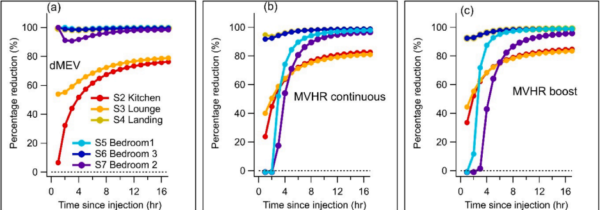
This study, conducted in the Energy House 2.0 at the University of Salford, offers an in-depth experimental evaluation of various ventilation and mitigation strategies in a full-scale, Future Homes Standard-compliant house. The research facility features environmental chambers capable of simulating conditions experienced by 95% of the global population, providing a controlled environment for testing. The study employed a standardized experimental protocol using controlled tracer gas and particulate injections, alongside real cooking scenarios, to assess the performance of different ventilation systems. These included decentralised mechanical extract ventilation (dMEV), mechanical ventilation with heat recovery (MVHR) in both continuous and boost modes, and portable air purification units. The test house, equipped with advanced atmospheric instruments and air quality sensors, allowed for detailed tracking of pollutant movement and dispersion patterns across different rooms. This comprehensive approach ensured that the evaluation of ventilation strategies was both controlled and reproducible, offering reliable insights into their effectiveness in reducing indoor air pollution.
Findings: Strategies for Cleaner Indoor Air
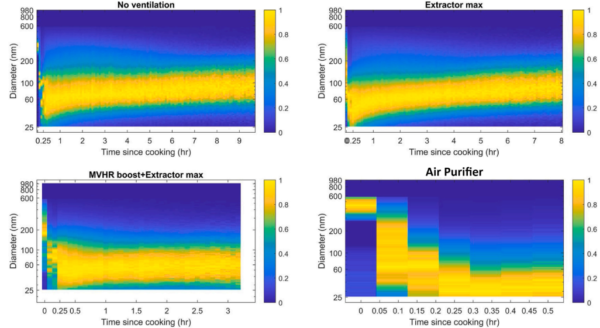
The study’s results are promising, demonstrating that all active ventilation strategies significantly reduced pollutant concentrations, with peak improvements exceeding 95% compared to scenarios with no ventilation. Among the tested systems, the MVHR boost mode and portable air purifiers proved most effective in rapidly removing particulates. While the MVHR continuous mode also improved air quality, it exhibited slower clearance rates following pollutant introduction. These findings provide actionable guidance for the design, operation, and regulation of ventilation systems in future housing, emphasizing the importance of embedding IAQ as a core performance criterion alongside energy efficiency and carbon reduction goals.
Implications for Future Housing Design
This research offers valuable insights into the integration of IAQ considerations in the design of net-zero homes. By highlighting the effectiveness of various ventilation and mitigation strategies, it paves the way for healthier living environments in energy-efficient housing. The study underscores the need for ongoing evaluation and adaptation of ventilation technologies to meet the evolving standards of future homes. As the UK moves towards its 2025 goals, these findings will be instrumental in ensuring that the transition to net-zero homes does not compromise indoor air quality, ultimately protecting both environmental quality and occupant health.
Reference: Navaneeth Meena Thamban et al. “Indoor air quality in UK future standard homes: Experimental evaluation of mitigation and ventilation strategies.” Building and Environment 297 (2026) 114515. DOI: https://doi.org/10.1016/j.buildenv.2026.114515