
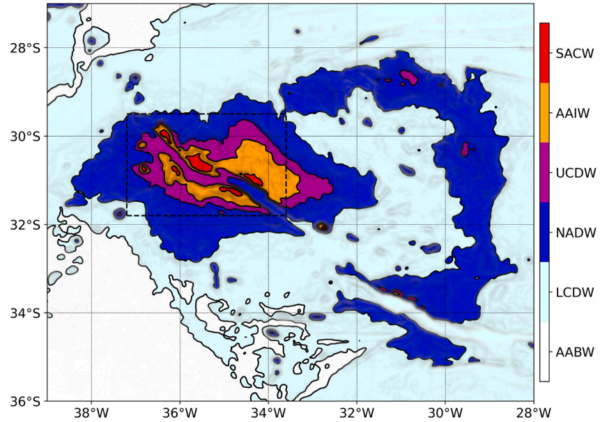
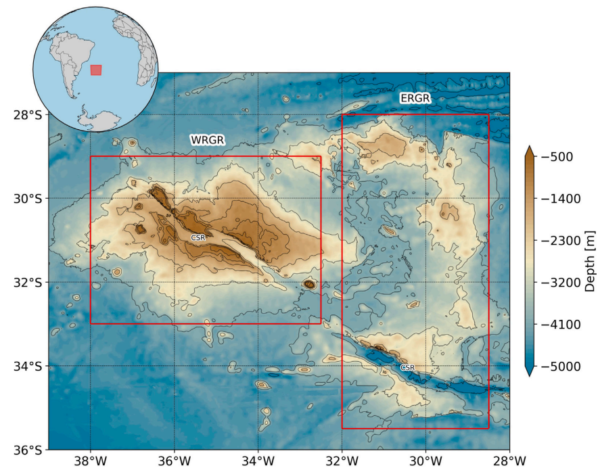
Researchers have unveiled the hydrodynamic mechanisms preserving ferromanganese crusts in the West Rio Grande Rise. This study highlights the role of ocean currents in maintaining these mineral-rich deposits, which are crucial for future exploitation given their wealth of critical metals and rare earth elements.
Ferromanganese Crusts: Geological Marvels with Economic Potential
The West Rio Grande Rise (WRGR), a significant oceanic elevation in the Southwestern Atlantic, harbors extensive ferromanganese crust deposits. These crusts are rich in critical metals and rare earth elements, making them economically and scientifically significant. Understanding the processes behind their exposure and preservation involves complex interactions of environmental factors, such as nutrient availability, oxygen levels, biological activity, and hydrodynamic forces.
In the WRGR, crust formation is influenced by hydrodynamic processes occurring between 500 to 1500 meters. These processes are driven by an intense anticyclonic mean current resulting from interactions between strong tidal currents and the South Equatorial Current’s southern branch with local topography. This study explores how these currents affect crust exposure and preservation in the shallower WRGR regions.
Dual Approach: Statistical and Hydrodynamic Modeling
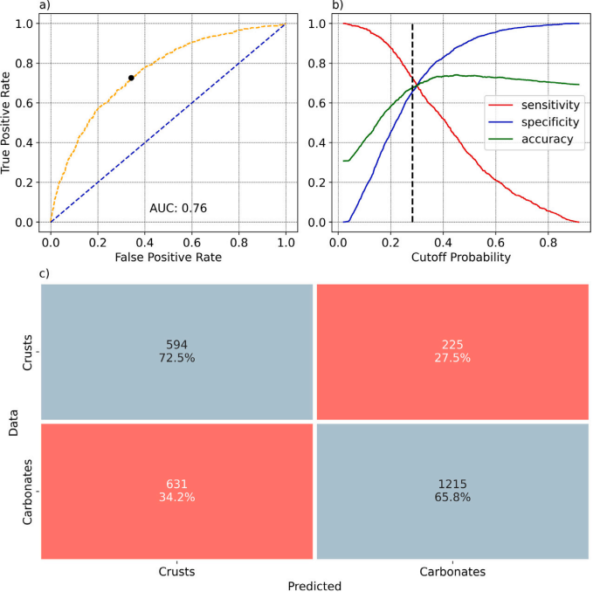
The researchers used a dual-method approach to test the hypothesis that near-seabed currents are vital for the exposure and preservation of ferromanganese crusts. A statistical classification model identified key environmental factors distinguishing ferromanganese crust from carbonate deposits, including conservative temperature, absolute salinity, mean flow speed, and tidal amplitude. These factors reflect the water masses’ structure that influences sediment transport and crust exposure.
A coupled hydrodynamic–sediment transport model simulated the region’s hydrodynamics. The Coastal and Regional Ocean COmmunity model (CROCO) was used to solve equations for potential temperature, salinity, and velocity. The simulation, covering 24°W to 44°W and 24°S to 38°S, incorporated a 1.8 km horizontal resolution and 30 vertical levels, adjusting to local topography. The model ran from January 2015 to December 2019, with the initial years for model spin-up and the last years for analyzing mean seabed velocity, temperature, and salinity. Tidal forcing was prescribed using TPXO7, and the model’s performance was evaluated against World Ocean Atlas 2018 data and a 14-month mooring time series.
Hydrodynamics: Key to Crust Exposure
The study highlights hydrodynamics’ crucial role in maintaining ferromanganese crust exposure in the WRGR. Statistical analysis showed that up to 80% of crust areas could be explained by identified hydrodynamic patterns. Strong near-seabed currents inhibit sediment deposition, maintaining crust exposure and allowing continued accumulation of valuable metals and minerals.
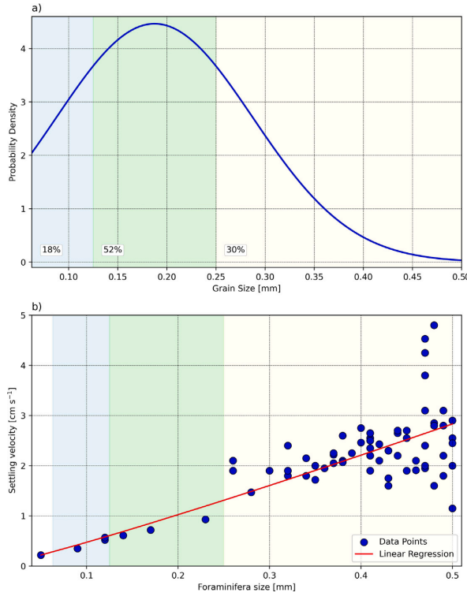
Hydrodynamic modeling confirmed that intense currents, especially the M2 tidal component, create zones of sediment deposition and non-deposition. Ferromanganese crusts are found in deeper, high-energy areas where currents prevent sediment accumulation, while carbonate sediments form in shallower, lower-energy zones. These findings emphasize hydrodynamics’ role in regulating sediment transport, localized erosion, and crust outcrop distribution.
Exploring Oceanic Resources: Future Directions
This research offers insights into the oceanic processes governing ferromanganese crust exposure and preservation. Understanding hydrodynamic controls aids in predicting favorable exploration sites and informs sustainable resource extraction strategies. As demand for critical metals and rare earth elements grows, this study provides a framework for responsible oceanic resource exploration and management. Reference: Pedro W.M. Souza-Neto et al. Hydrodynamic control over shallow ferromanganese crust deposits in the West Rio Grande Rise. DOI: https://doi.org/10.1016/j.rsma.2026.104833