
This study investigates how hydrodynamic conditions influence microplastic bioaccumulation in fish, highlighting the role of water flow in increasing toxicity. By combining biomarker analysis with machine learning, the research provides new insights into ecological risk assessments and the implications for food safety.
Microplastics: A Growing Concern
Microplastic (MP) pollution is a significant environmental issue, especially in aquatic ecosystems where these particles, smaller than 5 mm, accumulate and threaten marine life and food safety. Rivers are pivotal in transporting MPs to marine environments, with hydrodynamic conditions affecting the suspension and distribution of these particles. Despite awareness of hydrodynamics in MP transport, its role in bioaccumulation and toxicity in fish is underexplored. This study addresses this by examining the impact of hydrodynamic conditions on MP bioaccumulation in the edible freshwater fish species, Ctenopharyngodon idella.
Fish are particularly susceptible to MP ingestion due to their constant exposure to contaminated water and sediments. MPs are absorbed through the skin, gills, and intestines, migrating to internal tissues like muscles and liver. The accumulation of MPs is linked to physiological and biochemical disturbances, including oxidative stress, neurotoxicity, immune imbalance, and metabolic disruption. These effects are especially concerning in fish muscles, which are significant for ecological and human health. Existing studies often isolate MPs exposure or hydrodynamic stress, overlooking their combined effects on fish muscle, a gap this research aims to fill.
Comprehensive Research Methodology
The study employed a detailed approach to assess hydrodynamics’ effects on MP bioaccumulation in fish. Researchers exposed juvenile grass carp to 5 μm polystyrene MPs under static conditions and at water velocities of 1, 3, and 5 body lengths per second (BL/s), simulating natural river conditions where MPs are intermittently introduced by storm events and sediment resuspension.
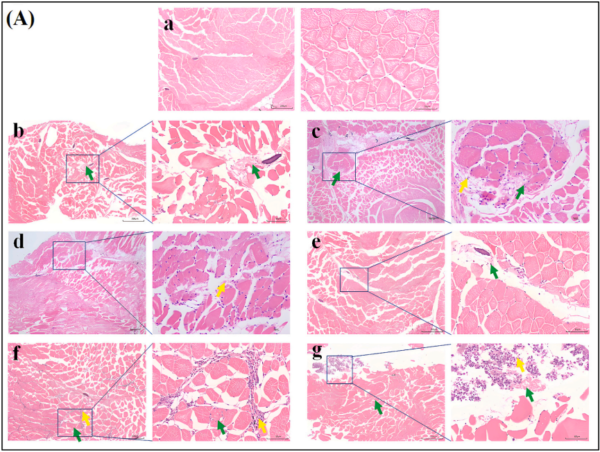
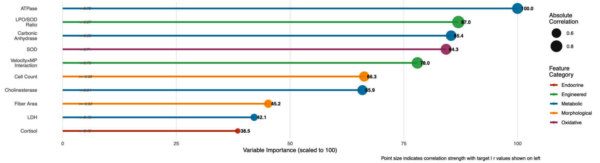
Muscle tissues were analyzed using fluorescence spectrophotometry to quantify MP bioaccumulation. Histopathological analysis assessed muscle damage, while various biomarkers were measured to evaluate oxidative stress, neurotoxicity, and metabolic disruption. The study used machine learning and structural equation modeling (SEM) to identify key predictive biomarkers and elucidate interactions between MPs exposure, hydrodynamic forces, and physiological responses.
Significant Findings
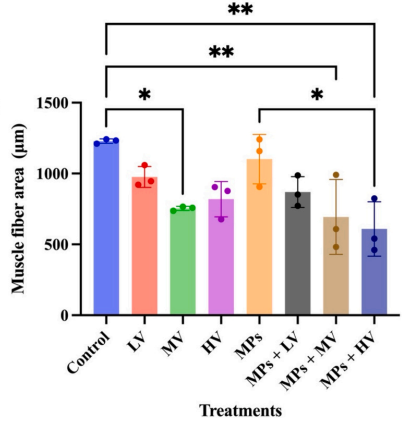
The research found that fish exposed to higher water velocities showed the highest levels of MP bioaccumulation, with significant histological damage such as fiber degeneration, necrosis, and hemorrhage. Biomarkers indicated oxidative stress, neurotoxicity, and disrupted energy metabolism, highlighting systemic stress and reduced tissue quality. Machine learning identified ATPase, superoxide dismutase, and cholinesterase as key predictive biomarkers with an accuracy of 87.5%.
These findings challenge traditional static-exposure paradigms in MP toxicity studies, demonstrating that hydrodynamics significantly drive MP bioaccumulation and its effects. The research underscores the need to incorporate hydrodynamic factors into ecological risk assessments.
Future Directions and Implications
This study provides a framework for assessing MP hazards in freshwater ecosystems, emphasizing the importance of considering hydrodynamic conditions in environmental assessments. The integration of machine learning and advanced modeling techniques offers a powerful tool for predicting high-risk exposure scenarios and identifying key biomarkers of toxicity.
The authors’ work opens new research avenues into the synergistic effects of environmental stressors on aquatic life, with significant implications for food safety and ecological risk management. The authors welcome engagement and collaboration for further exploration or insights into this topic.
Reference: Majid Rasta, Niloofar S. Lashkaryan, Xiaotao Shi, Mojtaba S. Taleshi, Ali Haghi Vayghan, Azin Ahmadi, Mian Adnan Kakakhel, Jia Manke, Liming Liu, Yujiao Wu. “Hydrodynamic modulation of microplastic bioaccumulation in edible fish: Integrating biomarker networks, machine learning, and food safety perspectives.” Food Chemistry 509 (2026) 148610. DOI: https://doi.org/10.1016/j.foodchem.2026.148610