
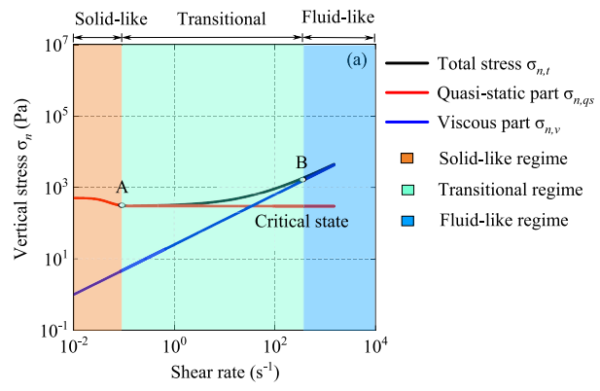
This study introduces a Critical-State Hydrodynamic Model (CSHM) that captures the complex solid-fluid phase transition of clay. By integrating quasi-static and viscous stress components, the model enhances understanding of clay’s behavior during geohazards such as landslides, offering a comprehensive predictive framework.
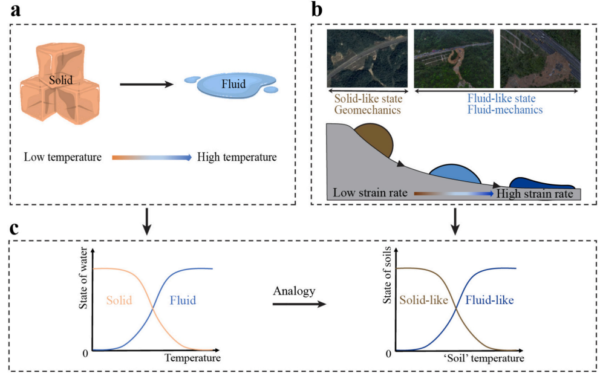
Phase transition phenomena. (a) Phase transition of water. (b) Phase transition of soils in debris flows (Xue et al., 2025). (c) Possible solid-fluid phase
transition mechanism for soils in analog with water (Raz and Levine, 2023).
The Challenge of Modeling Clay Behavior
Clay’s transition from a solid to a fluid state is pivotal in geohazards like landslides and debris flows, posing significant risks to infrastructure and human life. Understanding and predicting clay behavior under stress is essential, yet challenging due to its dual nature—exhibiting both frictional yielding and strain-rate-dependent fluidization. Existing models often fail to fully capture clay’s behavior, especially during rapid transitions, leaving a gap in accurately predicting geohazards.
The complexity of clay’s behavior stems from its multidisciplinary nature, involving principles from soil mechanics and fluid mechanics. Soil mechanics typically addresses solid-like responses, focusing on small-strain and small-strain-rate regimes, while fluid mechanics deals with large-strain-rate regimes where viscous properties dominate. Neither discipline fully captures clay’s transitional behavior, which can shift from solid-like to fluid-like states under varying conditions.
The critical state theory in soil mechanics describes the point at which soil under sustained shear will no longer change in stress or volume. However, it does not account for the strain-rate effects crucial for understanding clay’s transition to a fluid-like state. Similarly, fluid mechanics frameworks often neglect solid-like responses at small strains, such as elastoplasticity and frictional yielding. This division presents a significant challenge in developing a unified model describing the full range of clay’s phase transition.
Innovative Approach to Modeling
The research presents a Critical-State Hydrodynamic Model (CSHM) that integrates quasi-static and viscous stress components within a unified framework, addressing limitations of existing models. This approach allows for a comprehensive representation of clay’s nonlinear solid-fluid phase transition.
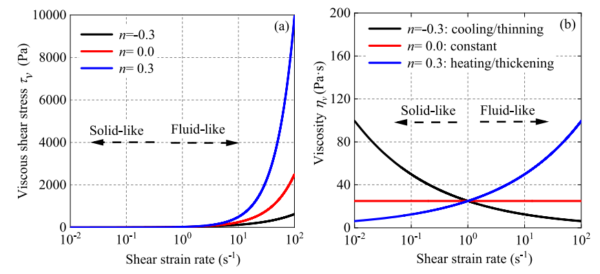
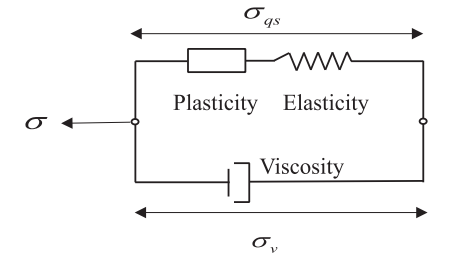
The CSHM employs a critical-state-based elastoplastic model to describe the quasi-static stress component, capturing clay’s solid-like behavior. This component accounts for nonlinear elasticity, stress dilatancy, and the critical state, providing a robust foundation for understanding clay’s initial solid-like responses. The viscous stress component is modeled using a new hydrodynamics-based rheological approach, introducing a state variable termed “clay temperature.” This concept captures fluid-like behavior, including shear-heating and shear-cooling rheology, essential for understanding the transition to a fluid-like state.
The model’s effectiveness was evaluated through extensive element simulations, demonstrating its ability to accurately capture clay’s phase transition dynamics. By decomposing the total effective stress into quasi-static and viscous components, the CSHM provides a seamless transition from solid-like to fluid-like states, overcoming discontinuities and limitations of previous models.
Key Findings and Insights
The CSHM successfully captures the complex solid-fluid phase transition of clay, validated against experimental data. The study reveals that clay’s transition is characterized by two key transitional points: the critical-state point and the viscous-stress-dominant point, leading to three distinct regimes—solid-like, transitional, and fluid-like. Unlike sand, which undergoes shear-induced heating, clay exhibits shear-cooling, a phenomenon accurately captured by the CSHM.
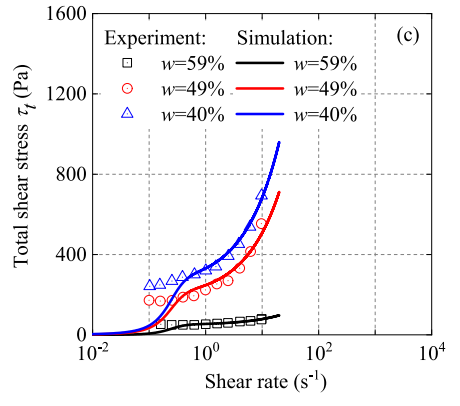
Furthermore, the CSHM is a 3D full-range phase transition model, unlike traditional models that only describe stress in the fluid-like state. This comprehensive approach allows for the accurate representation of clay’s behavior from the initial state through to the critical state and eventually to the fluid-like state, providing valuable insights for predicting geohazards.
Future Directions and Impact
The introduction of the CSHM marks a significant advancement in modeling clay’s phase transition, offering a powerful tool for engineering geology applications, particularly in analyzing and predicting flow-like landslides. By bridging the gap between soil mechanics and fluid mechanics, this model provides a more accurate and reliable framework for understanding and mitigating geohazard risks.
The research paves the way for future studies to further refine and expand the model’s capabilities, potentially incorporating additional factors such as time-dependent behaviors and environmental influences. The authors’ contribution is invaluable, inviting further exploration and collaboration to enhance understanding of soil behavior in complex geological events.
Reference: Hang Feng, Zhen-Yu Yin, Wei Cheng. “Beyond critical state: A critical-state hydrodynamic model (CSHM) for solid-fluid phase transition of clay.” Engineering Geology 366 (2026) 108671. DOI: https://doi.org/10.1016/j.enggeo.2026.108671