Computer Science

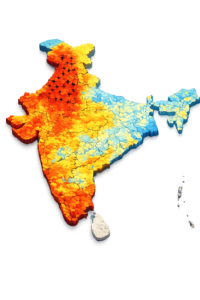
Satellite Data Reveals Regional Patterns in India’s Groundwater Depletion

Utilizing GRACE gravity measurements, ERA5 precipitation records, and MODIS land cover classifications, this analysis examines seasonal and regional variations in groundwater storage across India, identifying negative correlations with cropland and urban expansion in northern areas while emphasizing the need for diversified water management to address ongoing depletion. Groundwater Depletion in India: The Problem and Its […]

Satellite Data Reveals Regional Patterns in India’s Groundwater Depletion Read More »

Optimised RANSAC for UAV-Derived Point Clouds

Enhancing Photogrammetric Accuracy: ELISAC Improves Inlier Detection by Up to 57%, Reduces Computation Times, and Yields More Detailed DSMs from UAV Imagery in Forested Environments, Overcoming Spectral and Textural Similarities That Challenge Conventional Algorithms, Essential for Precise 3D Modeling Applications. Outlier Challenges in UAV Image Matching: Issues and Significance Matching corresponding points across overlapping images

Optimised RANSAC for UAV-Derived Point Clouds Read More »

Hammer of justice strikes down on AI, for ethical AI

Governance For Ethical AI

Integrating Trustworthiness, Lifecycle Stages, and Stakeholder Roles: A Framework for Addressing AI’s Data-Driven Challenges and Ensuring Ethical Deployment with Actionable Insights for Risk Mitigation and Regulatory Compliance Across Sectors Challenges in AI Governance and Their Significance Artificial intelligence systems have advanced beyond prototypes to support essential functions in sectors such as finance, healthcare, and logistics.

Governance For Ethical AI Read More »

Quay Amsterdam canal construction INSAR SHM

Structural Health Monitoring throught enhanced MT-InSAR

This research introduces a structural-based inverse approach that integrates MT-InSAR characteristics with numerical simulations of damage mechanisms, enabling the identification of the minimum number and optimal placement of persistent scatterers to assess surface displacements’ representativeness for specific infrastructure monitoring needs, surpassing traditional density-based evaluations in precision and reliability. The Challenge in Infrastructure Monitoring A significant

Structural Health Monitoring throught enhanced MT-InSAR Read More »

The Comprehensive Global Building Dataset: GlobalBuildingAtlas

GlobalBuildingAtlas introduces an open dataset with global coverage of 2.75 billion building polygons, 3 m resolution height maps, and LoD1 3D models, derived from satellite imagery, offering enhanced detail for urban analysis, planning, and monitoring progress toward the UN’s Sustainable Development Goals. The Need for Detailed Global Building Information Buildings serve as the foundation of

The Comprehensive Global Building Dataset: GlobalBuildingAtlas Read More »

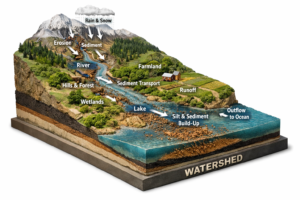
Why Are Some Watersheds More Sediment-Productive Than Others? An Explainable AI Approach

High-frequency turbidity sensors from 134 USGS stations, paired with RUSLE erosion estimates and explainable random forest models, map sediment yield and delivery ratios across the contiguous United States, revealing that human-modified landscapes dominate sediment transport efficiency while natural factors control total production, and highlighting priority sub-basins for targeted management in the Upper Mississippi and Chesapeake

Why Are Some Watersheds More Sediment-Productive Than Others? An Explainable AI Approach Read More »

Machine Learning for Iceberg Stability: Ground Imagery and Logistic Regression Offer New Practical Insights

Analyzing thousands of icebergs captured in time-lapse footage from Alaska and Greenland, this research demonstrates that logistic regression applied to visible width and height can help estimate the probability of instability providing engineers with a foundational, field-derived method for assessing capsize risk in Arctic coastal environments. The Challenge of Iceberg Capsize in Arctic Waters Iceberg

Machine Learning for Iceberg Stability: Ground Imagery and Logistic Regression Offer New Practical Insights Read More »

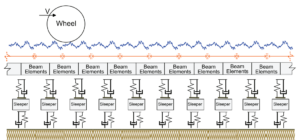
Bidirectional LSTM Networks Enable High-Resolution Railway Track Stiffness Monitoring from Drive-By Vibrations

TU Delft researchers present an LSTM-BiLSTM architecture that combines sleeper-level framing of axle-box acceleration signals with LSTM-based temporal feature extraction and bidirectional processing to deliver accurate, simultaneous estimation of railpad and ballast stiffness at individual sleeper resolution — even under realistic measurement noise. The Critical Need for Accurate Track Stiffness Monitoring Railway track stiffness is

Bidirectional LSTM Networks Enable High-Resolution Railway Track Stiffness Monitoring from Drive-By Vibrations Read More »

Monitoring Amsterdams Bridges with InSAR

A structured Delft–Amsterdam research collaboration integrates bridge typologies, expected failure mechanisms, and satellite viewing geometry to translate one-dimensional MT-InSAR measurements into practical damage indicators, demonstrating how regional-scale millimetre-level displacement data can support systematic structural evaluation of urban bridge networks. The Urban Bridge Monitoring Dilemma Across Europe and beyond, bridge networks are aging under increasing traffic

Monitoring Amsterdams Bridges with InSAR Read More »

Low-Cost SFCW Radar Platform Advances Sub-Daily Environmental Monitoring

Researchers have developed an affordable tower-mounted SFCW radar built around a compact SDR-based VNA and enhanced RF front end. Operating in L- and C-bands with dual polarization, the system captures high-temporal-resolution microwave data on soil, vegetation, and snow processes—directly addressing the temporal gaps that limit satellite observations of rapid Earth system dynamics. The Challenge of

Low-Cost SFCW Radar Platform Advances Sub-Daily Environmental Monitoring Read More »