
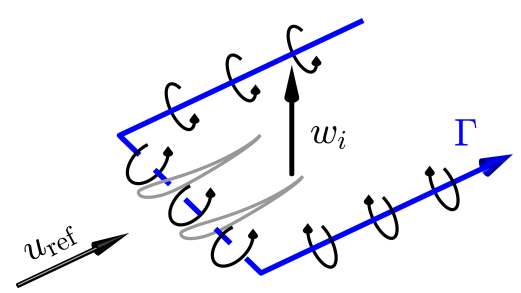
Regenerative wind farms, featuring multi-rotor systems with lifting devices (MRSLs), offer a promising advancement in wind energy. These systems can nearly double wind farm efficiency by enhancing vertical energy entrainment, potentially transforming renewable energy landscapes and significantly reducing costs.
Challenges in Conventional Wind Farms
devices (MRSLs).
Wind farms have become a cornerstone of renewable energy, leveraging clusters of wind turbines to harness the power of the wind. However, the conventional design of these farms, primarily consisting of three-bladed horizontal-axis wind turbines (HAWTs), faces significant challenges. The arrangement of turbines in close proximity, while economically beneficial, leads to substantial losses in annual energy production (AEP) due to turbine-turbine wake interactions. These interactions cause a depletion of kinetic energy in the wind as it passes through upstream turbines, leaving insufficient energy for downstream turbines to operate at optimal efficiency.
Studies have shown that energy production losses can range from 10% to 25% in large-scale offshore wind farms, with potential losses exceeding 60% in very large-scale farms. The primary culprit is the limited vertical energy entrainment in conventional wind farms, which rely heavily on turbulent mixing processes to replenish energy. This limitation significantly constrains the efficiency of large wind farms, as the vertical energy entrainment rates are notably lower than the typical installation capacity.
Addressing these inefficiencies is crucial for the future of wind energy, as it holds the promise of not only increasing the capacity factors of wind farms but also reducing the spatial and environmental impacts associated with wind energy generation. The need for innovative solutions that can enhance wake recovery and improve energy entrainment is more pressing than ever.
Innovative Solutions for Enhanced Efficiency
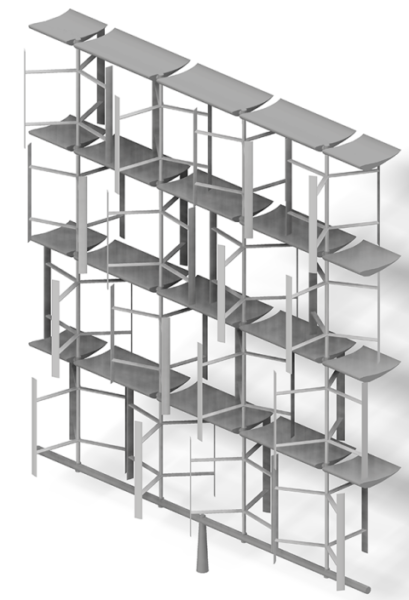
In response to the limitations of conventional wind farms, researchers from the Delft University of Technology have explored the potential of regenerative wind farms utilizing multi-rotor systems with lifting devices (MRSLs). These systems are designed to generate strong vertical forces using large airfoil structures, fundamentally altering the vertical energy entrainment process.
The concept of MRSLs builds on previous studies that demonstrated the potential of lifting devices to improve downstream turbine performance. Unlike traditional wind farms, which rely on turbulent mixing for energy replenishment, regenerative wind farms employ vertical advection processes. This is achieved by mounting lifting devices onto the wind energy harvesting systems, inducing strong vertical flows and enhancing vertical energy entrainment.
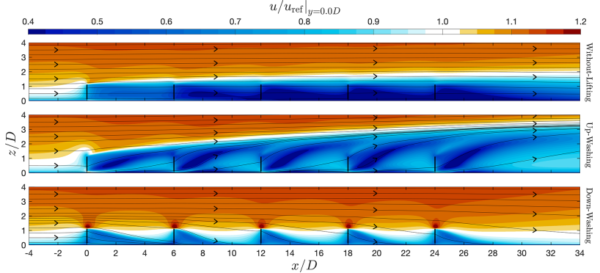
The MRSL design, realized at a wind tunnel scale, comprises several sub-rotors in the form of vertical- or horizontal-axis wind turbines, equipped with wings that serve as structural components. The innovative design facilitates an active exchange of flow between upper and lower layers, inspired by the flow field induced by a wing’s vortex system. This setup allows for a significant enhancement in wake recovery rates, with MRSLs achieving over 90% recovery at a distance of 5 rotor diameters downstream, compared to less than 40% for typical HAWTs.
Significant Improvements and Future Prospects
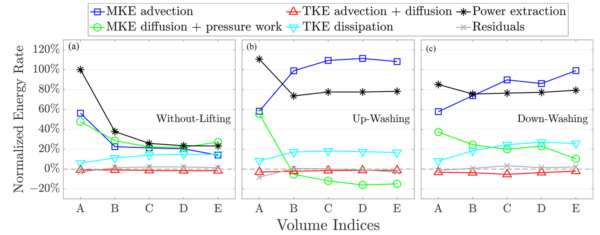
The numerical simulations conducted in this study reveal that regenerative wind farms with MRSLs can nearly double the efficiency of traditional wind farms under tested conditions. The introduction of lifting devices leads to a profound improvement in wake recovery rates, fundamentally changing the mechanism of vertical energy entrainment within wind farms.
This breakthrough not only promises significant economic advantages by increasing the capacity factors of wind farms but also suggests a reduction in the space required to achieve the same power output. The study highlights that the implementation of MRSLs does not necessitate major technological breakthroughs, as the technology for multi-rotor systems already exists, making the transition to this innovative design feasible.
Transformative Potential in Renewable Energy
The findings of this research mark a transformative advancement in the field of renewable energy. By fundamentally altering the process of vertical energy entrainment, regenerative wind farms have the potential to revolutionize wind energy, offering a more efficient and cost-effective solution for future energy needs.
This study sets the stage for further exploration and implementation of MRSLs in real-world wind farms. The potential to enhance the benefits of wind energy while minimizing environmental and spatial impacts is a promising prospect for the industry. The authors invite further discussion and collaboration to advance this groundbreaking concept.
Reference: YuanTso Li, Wei Yu, Andrea Sciacchitano, and Carlos Ferreira. “Numerical investigation of regenerative wind farms featuring enhanced vertical energy entrainment.” Wind Energ. Sci., 10, 631–659, 2025. DOI: https://doi.org/10.5194/wes-10-631-2025