
This research examines how declining launch costs have influenced the satellite industry, focusing on the rise of small satellites and SpaceX’s role. It provides empirical insights into how these cost reductions have transformed satellite deployment and the broader space economy.
The Satellite Revolution: Why It Matters
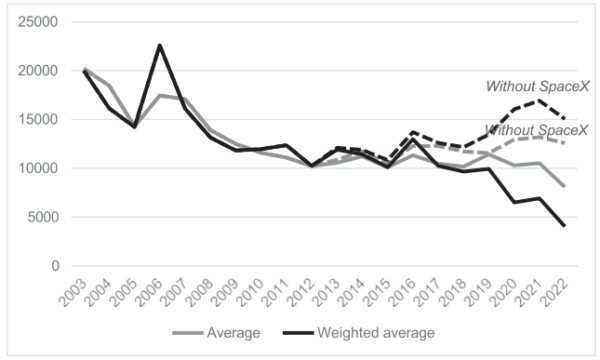
The global space sector has undergone a significant transformation over the past two decades, largely due to the rise of small satellites, or SmallSats. Weighing less than 500 kg, these satellites have become a major force in the market, altering our approach to space exploration. However, the extent to which falling launch costs have driven this shift is not fully understood. This relationship is crucial to understanding the New Space Economy (NSE), where private enterprises increasingly play key roles.
The NSE marks a shift from a government-dominated space sector to a decentralized ecosystem of private firms sharing risks and rewards. This transition emphasizes innovation and efficiency over risk aversion. As large conglomerates coexist with venture-backed start-ups, the industry is prioritizing modular production and scalable systems.
Despite business analysts’ focus on the NSE’s growth, academic research linking the SmallSat revolution to lower launch costs is sparse. This study aims to bridge that gap by exploring the connection between reduced launch prices and satellite miniaturization, as well as SpaceX’s pivotal role in making space more accessible.
Research Approach and Innovative Insights
The researchers used a comprehensive dataset of operational satellites launched between 2003 and 2022 to explore the link between launch affordability and small satellite proliferation. Six linear regression models assessed whether lower launch costs correlate with changes in payload composition and average satellite mass. This analysis aimed to reveal the statistical association between declining launch costs and the rise of small satellites.
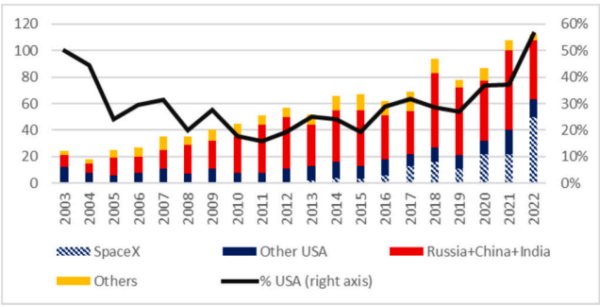
To ensure robust findings, the study also examined the effects of excluding low-cost, high-cadence launch services. This approach evaluated how recent changes in launch supply conditions affect satellite deployment patterns. The research considers the broader technological, organizational, and market developments interacting with declining launch costs.
SpaceX has significantly contributed to reducing launch costs. Its Falcon 9 and Falcon Heavy rockets have lowered the cost of launching payloads to Low Earth Orbit (LEO), making space more affordable. SpaceX’s success stems from technological innovations like partial reusability and a Silicon Valley-style business model focused on fast iteration and high risk tolerance.
Key Findings and Insights
The study finds a strong statistical association between lower launch costs and an increase in small satellites, alongside a marked decline in average satellite mass post-2013. This indicates that falling launch costs have significantly contributed to a small satellite-dominated orbital environment. Excluding low-cost, high-cadence launches weakens this relationship, underscoring the impact of recent launch supply changes.
The research provides empirical evidence that reduced launch costs have spurred the proliferation of small satellites, interacting with broader technological, organizational, and market shifts. These findings highlight how access-to-orbit economics influences system design, investment strategies, and competitive dynamics in the space economy. The study emphasizes SpaceX’s crucial role in reshaping the satellite industry through cost-effective launches.
Future Prospects and Industry Impact
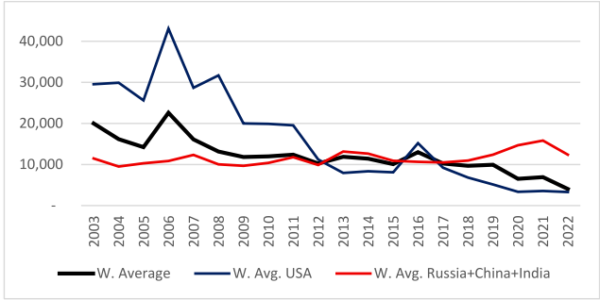
This research offers valuable insights into how declining launch costs have transformed the satellite industry, highlighting the role of small satellites and SpaceX in reshaping the space economy. As the industry evolves, understanding the interplay between launch affordability and satellite deployment will be vital for stakeholders navigating the New Space Economy.
The authors have advanced our understanding of the link between launch costs and satellite miniaturization. They encourage further exploration and collaboration to deepen our knowledge of the space industry’s future trajectory.
Reference: Edoardo Marcucci, Valerio Gatta, Cristiano Ciucci, Domenico Cucina. “When launch costs fall, do satellites shrink and constellations grow? The role of SpaceX in the SmallSat revolution.” Research in Transportation Business & Management 67 (2026) 101663. DOI: https://doi.org/10.1016/j.rtbm.2026.101663