
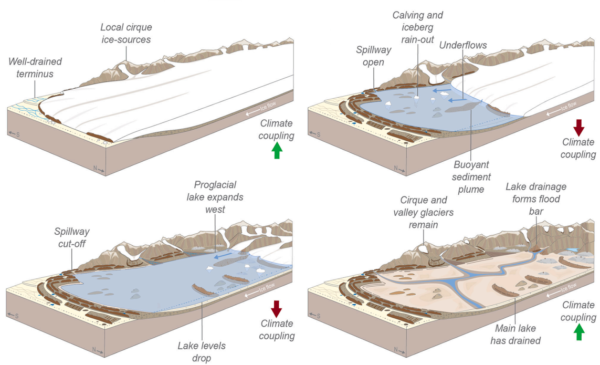
Researchers investigate the retreat of the Patagonian Ice Sheet, revealing the role of topography in glacier dynamics. This study offers new insights into past climate responses and the evolution of glacial landsystems, enhancing our understanding of glacier behavior in mountain icefield settings.
Decoding Glacier Retreat: A Closer Look
The Patagonian Ice Sheet, once a dominant force in the southernmost Andes, has experienced significant transformations over time. Its expansion and contraction left a variety of glacial landforms and sediments, documenting its historical extents and responses to past climate changes. Understanding these patterns provides insight into glacier-climate interactions that have shaped our planet’s history. The research centers on the Río Cisnes palaeo-outlet glacier in northeast Patagonia, where topography significantly influences glacier retreat patterns.
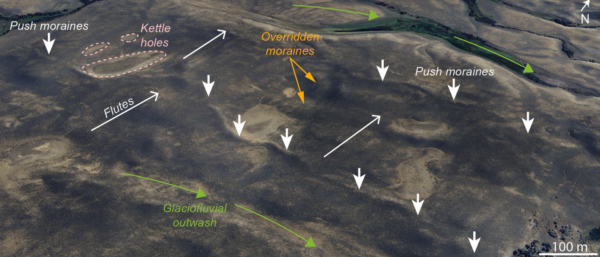
Google Earth Pro imagery.
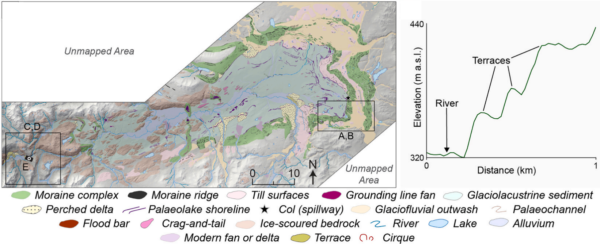
In mountain icefield settings, topography can greatly affect glacier retreat dynamics. The Río Cisnes valley, with its reverse-bed slope, offers a unique opportunity to study these dynamics. As glaciers retreat, they leave behind distinct geomorphic signatures, including erosional, ice-contact, subglacial, glaciofluvial, and glaciolacustrine landforms. These features provide essential insights into the processes and factors driving glacier retreat, serving as analogues for understanding glacier responses to climatic shifts over extended timescales.
This research is significant in addressing gaps in our understanding of Patagonian palaeo-glacier behavior. While previous studies have focused on broader geomorphological and chronological frameworks, this research examines the finer-scale geomorphological features of the Río Cisnes valley. It aims to identify the types of glacial landsystems present and their evolution during the Last Glacial-Interglacial Transition.
Mapping the Past: Methodology and Approach
The research team conducted comprehensive geomorphological mapping of the Río Cisnes valley to identify and characterize landforms associated with the retreat of the Río Cisnes palaeo-glacier. This detailed mapping was crucial in developing a conceptual model reflecting both temporary and permanent changes in glacial landsystems, as well as changes in the strength of glacier-climate coupling.
Researchers employed a glacial landsystems framework, using process-form regimes from modern analogue environments. This approach allowed them to interpret the landforms within the context of known glacial processes observed in contemporary glacier forefields. By comparing these findings with modern analogues, the researchers enhanced their understanding of the glacial dynamics at play.
The study identified three key components of the mountain icefield landsystem related to spatiotemporal changes during deglaciation: the active temperate outlet lobe landsystem, the temperate glaciolacustrine-calving outlet glacier landsystem, and the temperate cirque and valley glacier landsystem. The temperate glaciolacustrine-calving outlet glacier landsystem was characterized by two distinct developmental phases: an early stage marked by drainage via an Atlantic spillway and a late stage characterized by the abandonment of this spillway.
Unveiling Glacier Dynamics: Results and Conclusions
The research demonstrated that the spatial evolution of these landsystems was heavily influenced by the complex regional topographic setting. This setting facilitated the development of a large ice-dammed lake during glacier recession, leading to landsystem overprinting. The patterns and characteristics observed in these landsystems are likely to be repeated across other eastern outlet valleys of the Patagonian Andes.
The study’s findings highlight the importance of topography in shaping glacier retreat dynamics. By providing a detailed geomorphological record of the Río Cisnes palaeo-glacier, the research offers valuable insights into the style and manner of glacier recession in response to past climate changes. These insights have significant implications for interpreting palaeo-glacier chronologies and understanding the broader impacts of climate change on glacier dynamics.
Looking Ahead: Implications and Future Directions
This research advances our understanding of glacial landsystems in Patagonia and sets the stage for future studies to explore similar dynamics in other regions. Insights gained from this study could inform models predicting future glacier responses to climate change, particularly in mountainous regions where topography plays a crucial role.
We extend our gratitude to the authors for their invaluable contribution to the field of glacial geomorphology. For those interested in further exploring this research or contributing additional insights, we encourage engagement with this fascinating area of study.
Reference: Emma-Louise Cooper et al. Evolving glacier landsystems during Patagonian Ice Sheet recession influenced by a changing topographic setting. DOI: https://doi.org/10.1016/j.geomorph.2025.110148