
Researchers from Delft University of Technology have developed a calibration strategy for Discrete Element Method (DEM) modeling, enhancing simulation accuracy in blast furnace mixture charging under high-velocity conditions. This advancement aims to optimize ironmaking processes by addressing challenges related to material segregation and distribution.
The Crucial Role of Blast Furnace Efficiency
Blast furnaces are large industrial reactors where raw materials transform into liquid iron through thermal and chemical processes. These reactors depend on the precise arrangement of materials, known as the “burden,” which includes iron ore pellets, sinter, and coke. The efficiency of iron extraction is significantly influenced by the permeability distribution of this packed bed. Uneven permeability can lead to stability issues and increased coke consumption, impacting the overall efficiency and sustainability of furnace operations.
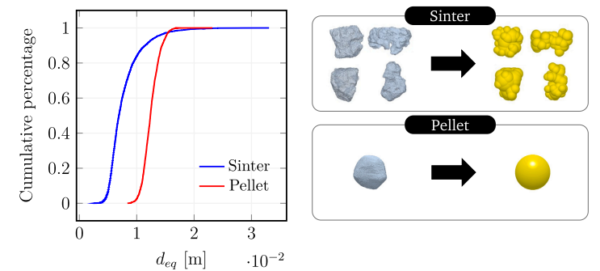
A major challenge in maintaining uniform permeability is the segregation of materials during the high-velocity charging process. As the mixture of pellets and sinter is charged into the furnace, differences in particle size, shape, and density can lead to non-uniform distribution, negatively affecting furnace efficiency and stability. Understanding and mitigating this segregation is crucial for optimizing the ironmaking process.
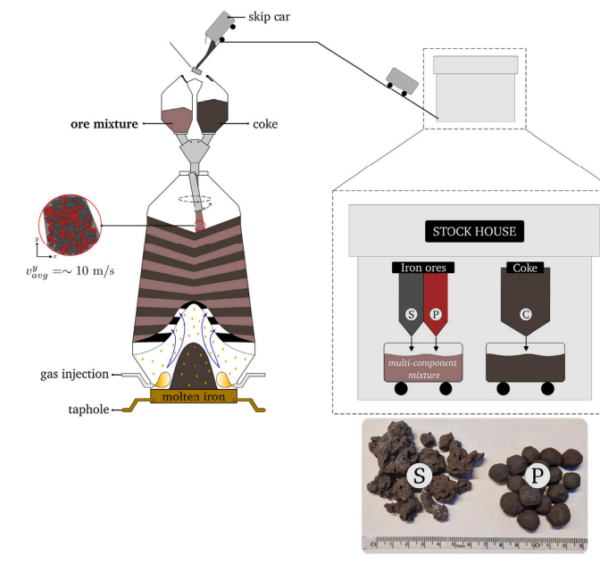
The Discrete Element Method (DEM) provides a powerful tool for simulating the blast furnace charging process, offering insights into particle behavior. However, the accuracy of these simulations relies on the precise calibration of model parameters. Traditionally, DEM models have struggled to accurately capture high-velocity behaviors and interactions between different materials, such as pellets and sinter. This study presents a systematic calibration approach to enhance the predictive accuracy of DEM models under realistic blast furnace conditions.
Refined Calibration and Verification Techniques
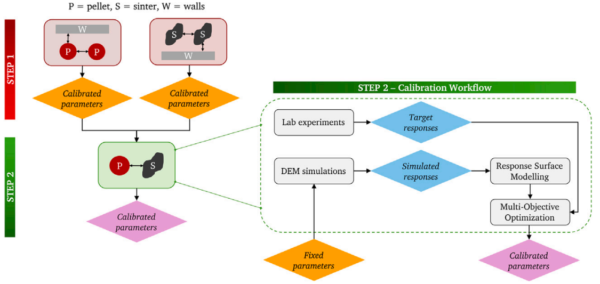
This research introduces a step-wise calibration strategy tailored for DEM modeling of blast furnace mixture charging. The approach begins with the calibration of individual interaction parameters for pellets and sinter at the highest flow velocity, representative of actual blast furnace conditions. This step focuses on optimizing parameters related to particle-particle and particle-wall interactions, which are critical for accurate simulation of material behavior.
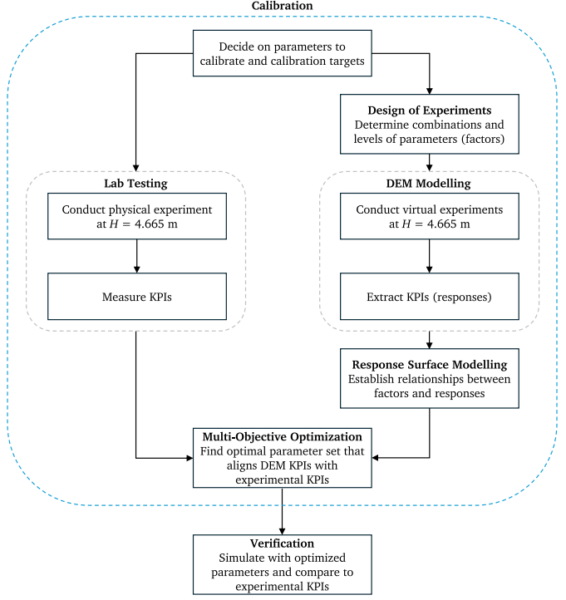
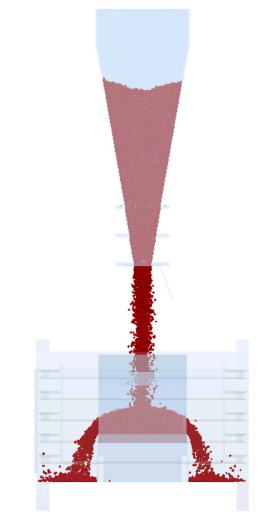
The researchers employed a high-velocity laboratory setup capable of simultaneously measuring five key performance indicators (KPIs) related to flow and packing behavior. These KPIs were measured at various discharge heights, corresponding to different flow velocities, ensuring a comprehensive understanding of material dynamics.
The calibration process involved creating response surface models for each KPI and using a multi-objective optimization approach with a desirability function to determine the model parameters. This methodology ensures that the calibration is not only accurate but also flow-invariant, meaning it can predict material behavior across different velocities.
Following the calibration of individual parameters, the study proceeded to calibrate the interaction parameters between pellets and sinter. This two-step calibration strategy significantly reduces the number of required KPIs, streamlining the process and enhancing the model’s accuracy in predicting real-world behavior.
Effective Outcomes and Implications
The study’s results demonstrate the effectiveness of the proposed calibration strategy. The calibrated DEM model accurately reproduced experimental data, indicating a high level of precision in simulating the flow and packing behavior of the pellet-sinter mixture under high-velocity conditions. The model’s predictions were consistent across different discharge heights, confirming its flow-invariant nature.
One of the key findings is that the calibration outcome is robust across various flow velocities, suggesting that the model can reliably predict material behavior in different operational scenarios. This advancement in DEM modeling addresses previous limitations related to the calibration of interaction parameters between different materials.
The study concludes that the proposed calibration approach not only enhances the accuracy of DEM simulations for blast furnace charging but also provides a framework applicable to other DEM-based mixture models. This opens up new possibilities for optimizing industrial processes that rely on precise material handling and distribution.
Future Directions and Broader Applications
This research marks a significant step forward in the calibration of DEM models for blast furnace applications. By providing a systematic and accurate calibration approach, it paves the way for more efficient and sustainable ironmaking processes. The methodology’s applicability to other DEM-based models suggests potential benefits across various industries dealing with complex material mixtures.
The authors invite further exploration into the integration of advanced models that consider particle breakage and degradation phenomena, which were beyond the scope of this study. Such advancements could further enhance the predictive capabilities of DEM models, offering greater insights into material behavior under extreme conditions.
We thank the authors for their valuable contribution to the field. For those interested in exploring this research further or sharing insights, please refer to the full publication.
Reference: Roeplal, R., Pang, Y., & Schott, D. (2026). Towards realistic DEM modeling of blast furnace mixture charging: Calibration and verification of model parameters under high-velocity flow conditions. Powder Technology, 467, Article 121382. DOI: https://doi.org/10.1016/j.powtec.2025.121382