
This study examines wildfire ignitions in mainland Portugal, focusing on municipal-scale analysis and spatial modeling to enhance fire management. By identifying key ignition drivers, the research aims to support targeted prevention strategies and policies, crucial for reducing human-caused ignitions and mitigating wildfire risk.
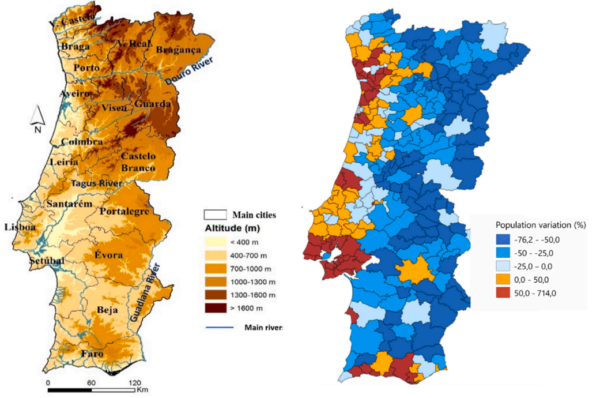
Wildfire Ignitions: A Pressing Issue in Portugal
Wildfires have historically shaped Mediterranean ecosystems, but their frequency and severity have increased across Europe due to natural and human factors. In mainland Portugal, understanding wildfire ignition dynamics is critical for effective fire management and risk reduction. Since the mid-20th century, rural depopulation, land abandonment, and fuel accumulation have shifted ignition sources from natural to predominantly human-induced. Portugal has the highest ignition densities in the Mediterranean, with notable regional differences and a north-south gradient. Despite previous research, the socio-economic and behavioral mechanisms behind these patterns are not fully understood.
The study by Nunes et al. focuses on the municipal scale, where governance structures are vital for fire prevention and suppression. It aims to map ignition hotspots, identify biophysical and human drivers using Multiscale Geographically Weighted Regression (MGWR), and assess how these relationships vary across municipalities, providing a framework for targeted prevention strategies and evidence-based policies.
Advanced Techniques: Municipal-Scale Analysis
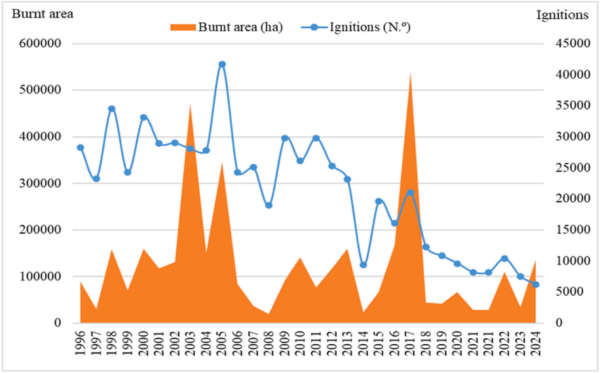
The research analyzes wildfire ignitions in mainland Portugal from 1996 to 2023 using national wildfire records from the Portuguese Institute for Nature and Forest Conservation (ICNF). It classifies forest fire causes into negligence, intentional acts, and reactivations. Moran’s I statistic evaluates spatial autocorrelation, while Getis-Ord Gi* statistics detect hotspots. The study employs MGWR with Golden Section Search bandwidth optimization to model spatial non-stationarity, capturing complex relationships and addressing spatial dataset uncertainties.
Explanatory variables include physical and demographic characteristics, land-use and land cover, and economic structures at the municipal level, derived from national census data and digital maps. Climatic variables, such as mean annual precipitation, describe mean conditions for the 1991-2020 period, enhancing the analysis.
Key Findings: Drivers and Patterns
The study finds that wildfire ignitions in mainland Portugal are strongly clustered, with persistent hotspots in the northwest and Lisbon regions and coldspots in the south. Negligence is the leading cause of ignitions, accounting for 47%, followed by intentional causes (27%) and reactivations (more than 25%).
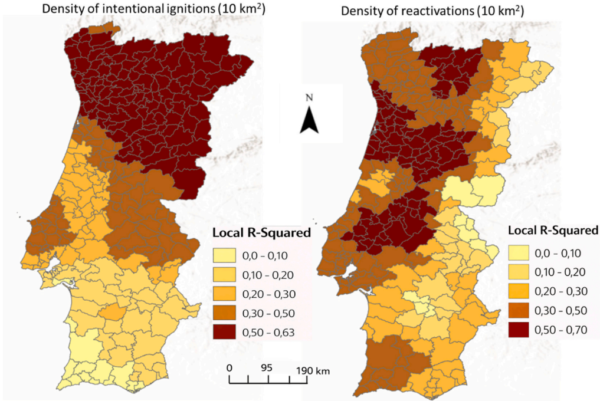
municipal level.
MGWR analysis reveals spatially varying relationships between ignition patterns and their drivers. Ignition density is positively associated with population density, precipitation, and shrubland cover. Negligent ignitions are linked to agroforestry, pasture, and agricultural land uses, as well as terrain ruggedness. Intentional ignitions show negative associations with rugged terrain and positive associations with illiteracy rates in specific municipalities. Reactivations are positively associated with firefighter density and influenced by shrubland cover.
Strategic Insights for Future Fire Management
This research highlights the importance of spatial scale and non-stationary modeling in understanding wildfire ignition processes. The municipal-scale analysis offers a framework for developing targeted fire prevention strategies and evidence-based policies. As fire weather conditions worsen, these insights are crucial for reducing human-caused ignitions and mitigating wildfire risk.
Reference: A.N. Nunes, L. Lourenço, Meira Castro A. C. “Wildfire causes in mainland Portugal: Municipal-scale hotspots and non-stationary spatial drivers.” Journal of Environmental Management 404 (2026) 129315. DOI: https://doi.org/10.1016/j.jenvman.2026.129315