
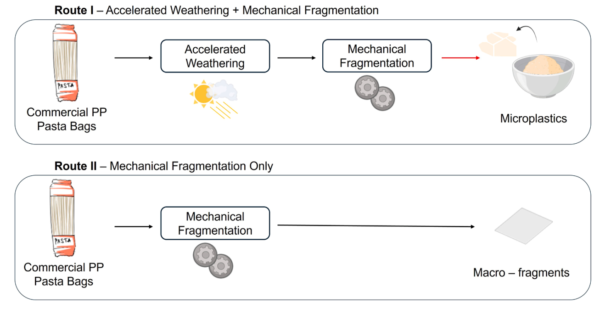
Researchers at the University of Palermo have devised a method to utilize microplastics from polypropylene pasta bags for removing pharmaceutical contaminants from water. This approach transforms an environmental challenge into a potential remediation tool, offering a sustainable solution for water purification.
Tackling the Microplastics Challenge
The growing prevalence of microplastics (MPLs) in natural environments is a pressing issue, threatening ecosystems and human health. These tiny plastic particles, often less than 5 mm in size, originate from the breakdown of larger plastic items. Polyolefins, such as polypropylene (PP) and polyethylene (PE), dominate this group due to their widespread use and durability. MPLs are not only pollutants themselves but also act as carriers for other contaminants, including pharmaceuticals, which are persistent in aquatic environments. Pharmaceuticals, like analgesics and antibiotics, pose significant ecological hazards due to their bioaccumulative nature and potential to modulate ecotoxicological effects. Despite the known risks, there is limited research on the interaction between realistic, environmentally aged MPLs and aquatic pollutants. Most studies rely on commercial MPLs, which do not accurately represent the properties and interactions of real-world microplastics. This gap in knowledge is critical as the adsorption capacity of MPLs is influenced by their chemical and physical properties, which change with environmental exposure. Understanding these interactions could unlock new methods for environmental remediation, using MPLs as sorbents to remove pollutants from water.
Innovative Research Approach
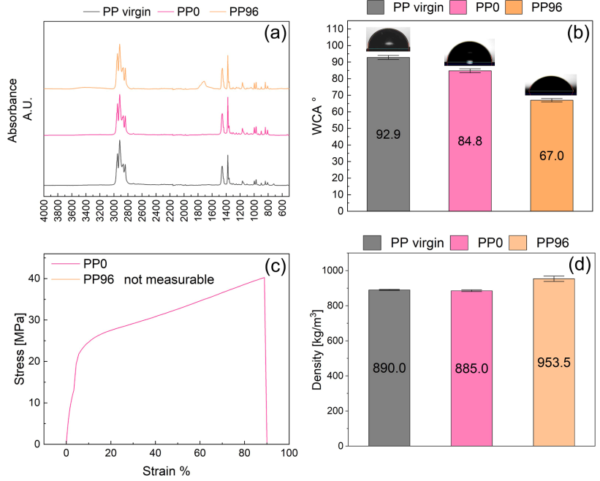
To address this issue, researchers at the University of Palermo conducted a study using true-to-life PP microplastics derived from post-consumer pasta bags. These bags were subjected to a process mimicking natural environmental aging, including photo-oxidation followed by mechanical fragmentation. The study involved two main routes: one involving photo-oxidation and the other excluding it. The photo-oxidation process was carried out using UVB-313 lamps, simulating environmental conditions over 96 hours. This process altered the chemical and physical properties of the PP, making it more reactive. The resulting microplastics were then tested for their ability to adsorb two common pharmaceutical contaminants: paracetamol (PCM) and ciprofloxacin (CFX). Various characterization techniques were employed to analyze the samples, including spectroscopic analysis, wettability tests, mechanical property assessments, density analysis, differential scanning calorimetry (DSC), and scanning electron microscopy (SEM). These analyses provided insights into the changes in surface chemistry, hydrophilicity, crystallinity, and morphology of the microplastics, which are crucial for understanding their adsorption capabilities.
Key Findings and Insights
The study found that the photo-oxidized PP microplastics exhibited significantly higher adsorption capacities for pharmaceutical contaminants compared to unaged PP. The adsorption kinetics were best described by the pseudo-second-order (PSO) model, indicating a two-step adsorption mechanism involving initial physical interactions followed by sorption. Paracetamol showed a higher affinity for the sorbents, while ciprofloxacin’s structural complexity resulted in slower adsorption kinetics. The research demonstrates that environmental degradation enhances the reactivity of MPLs, making them effective sorbents for pollutants. These findings suggest that photo-oxidized microplastics could be repurposed as an unconventional tool for environmental remediation, offering a sustainable approach to water purification.
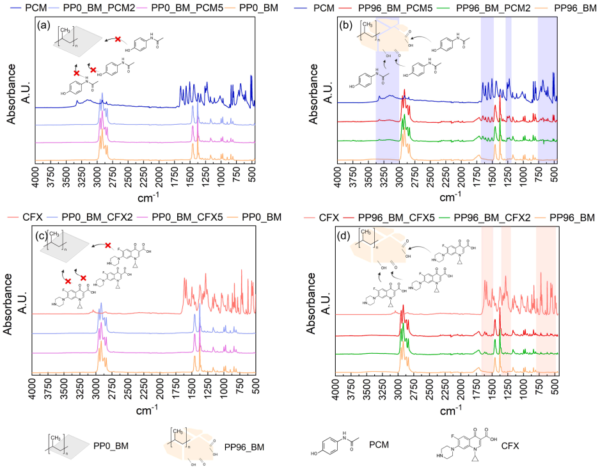
removal, (d) PP96_BM samples after CFX removal.
Future Directions and Opportunities
This innovative approach to using microplastics for environmental remediation highlights the potential for turning a pollutant into a solution. By exploiting the altered properties of environmentally aged microplastics, this research opens the door to new strategies for removing contaminants from water systems. The possibility of reusing these microplastics further enhances their appeal as a sustainable remediation tool. Future research could explore the scalability of this method and its application to other types of contaminants. The authors invite collaboration and input from the scientific community to advance this promising field of study.
Reference: Marta Balsamo, Maria Chiara Mistretta, Roberto Scaffaro. “True-to-life microplastics obtained from PP pasta bags for efficient removal of pharmaceutical contaminants in aqueous systems.” DOI: https://doi.org/10.1016/j.polymdegradstab.2026.112112