
Researchers investigate the complex interaction between Magellanic penguins and pumas in Argentina’s Monte León National Park. This study examines the emerging predator-prey relationship at the land-sea interface, highlighting its implications for conservation and ecosystem management.
Unraveling the Predator-Prey Puzzle
The expansion of Magellanic penguins into mainland Argentina has inadvertently introduced them as prey for recovering puma populations. This shift in dynamics, noted two decades ago, has not been thoroughly examined until now. The study focuses on Monte León National Park (MLNP), where this interaction is pronounced. Understanding this relationship is crucial as it highlights broader ecological concerns, such as the vulnerability of mainland seabird colonies to terrestrial predators.
Seabirds like the Magellanic penguins play a vital role in the ecosystem by transporting nutrients from marine to terrestrial environments. However, they are increasingly threatened by terrestrial predators, especially as these predators adapt to environmental changes and new prey opportunities. The introduction of a novel predator, such as the puma, can have significant consequences for seabird populations, affecting their reproductive success and survival rates.
In MLNP, the return of pumas to their original habitats, following a decline in livestock farming and the establishment of protected areas, has led to a unique ecological scenario. The penguins, which have expanded from island colonies to the mainland, now face a new predatory threat. This study assesses the impact of puma predation on the penguin population and explores the potential long-term effects on their survival.
Research Approach and Methodology
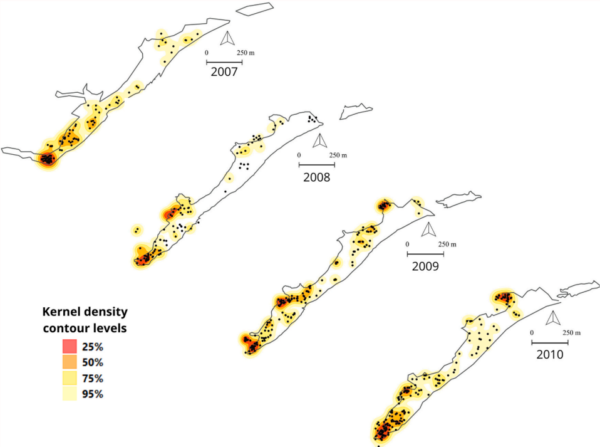
The research team conducted an extensive analysis of puma predation on penguins over four consecutive breeding seasons, from 2007 to 2010. They utilized a combination of field observations, carcass counts, and demographic modeling to understand the extent of predation and its impact on the penguin colony. The study focused on the spatial distribution of predation events, identifying hotspots at the colony’s southern and northern edges.
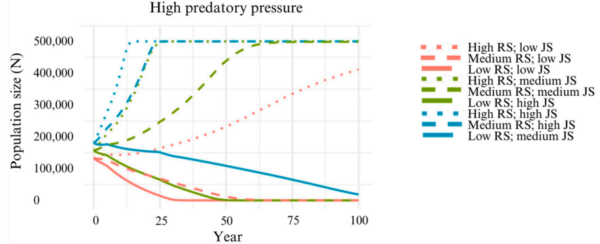
To predict the potential long-term effects of puma predation, the researchers employed Population Viability Analysis (PVA) models. These models incorporated various scenarios of reproductive success, juvenile survival, and puma-induced mortality rates. By simulating different conditions, the team could assess the potential for colony extinction and identify critical factors affecting population viability.

carcass in MLNP
The study also compared the MLNP colony with other Magellanic penguin colonies in the region to determine if similar predatory threats might exist elsewhere. This comparative approach aimed to provide a broader understanding of the implications of terrestrial predator expansion on seabird populations.
Key Findings and Insights
The study revealed that during the research period, an estimated 7,087 adult penguins were killed by pumas, accounting for 7.60% of the breeding population. Despite this significant predation pressure, the colony’s extinction was not directly attributed to puma predation. However, the population was highly sensitive to changes in juvenile survival and reproductive success.
The PVA models indicated that low reproductive success, combined with low or medium juvenile survival, could lead to extinction within 100 years. Even under scenarios of medium reproductive success with low juvenile survival, or low reproductive success with high juvenile survival, the population experienced substantial reductions. These findings underscore the importance of reproductive success and juvenile survival in maintaining population stability.
Conservation Implications
This research highlights a critical conservation concern: the increasing vulnerability of mainland seabird colonies to terrestrial predators like pumas. The study emphasizes the need for sustained monitoring of Magellanic penguin colonies to detect early signs of demographic decline and inform management actions to mitigate excessive predation.
By providing a comprehensive assessment of the predator-prey dynamics at MLNP, this study contributes valuable insights into the broader ecological impacts of terrestrial predator expansion. The findings serve as a call to action for conservationists and researchers to explore similar interactions in other regions and develop strategies to protect vulnerable seabird populations.
Reference: Melisa Lera, Esteban Frere, Jorgelina Marino, Annick Morgenthaler, Sandra Lai, Ana Millones. “Shifting predator – prey dynamics at the land – sea interface: The case of Magellanic penguins and pumas.” Journal for Nature Conservation 91 (2026) 127208. DOI: https://doi.org/10.1016/j.jnc.2025.127208