
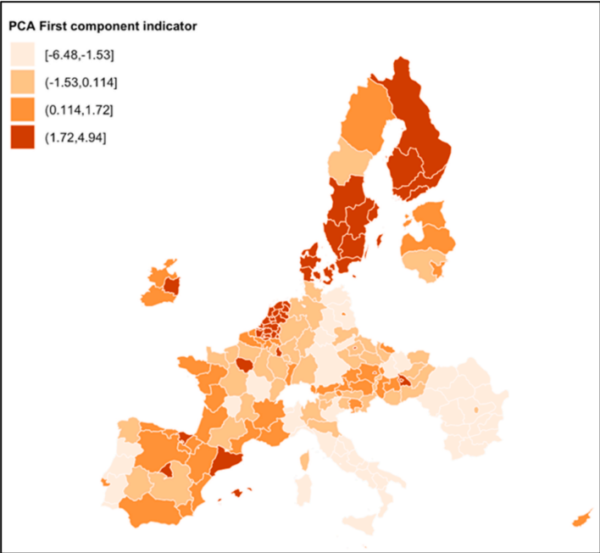
Researchers have developed a composite index to assess regional digitalization in Europe, incorporating spatial heterogeneity and dependence. This approach identifies digital winners and losers, offering a strategic tool to address territorial disparities and inform local digitalization policies, aligning with the EU’s cohesion goals.
Europe’s Digitalization Dilemma
Digitalization is reshaping economies and societies globally. In Europe, it is a major policy focus, with the EU investing heavily in initiatives like the Digital Europe Programme. Despite these efforts, a digital divide persists, with disparities in digital access and capabilities across regions. This divide is rooted in local contexts and geographical factors. The EU’s Digital Economy and Society Index (DESI) has been useful at the national level but falls short in capturing regional digital disparities. A more granular, regional-level analysis is needed, as digitalization levels vary significantly within countries due to factors like infrastructure, local policies, and socio-economic conditions.
Addressing these disparities is crucial for achieving the EU’s goals of socio-economic cohesion and balanced development. A persistent East-West divide in digital capabilities threatens to exacerbate fragmentation within Europe, undermining efforts to create a unified digital market. The challenge lies in developing a framework that can accurately capture regional digitalization patterns, taking into account spatial heterogeneity and interdependencies. This is where the research by Mazzaferro, Cartone, Postiglione, and D’Isidoro comes into play, offering a novel approach to measuring regional digitalization through a spatial composite index.
Breaking New Ground with a Spatial Composite Index
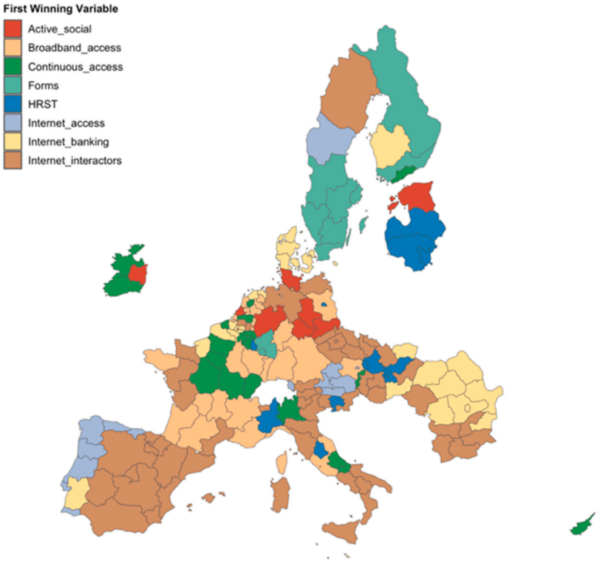
The researchers developed a regional composite index for digitalization, building on the DESI structure but extending it to address spatial dimensions. The methodology involved using Principal Component Analysis (PCA) to construct a baseline index, enhanced through Geographically Weighted Principal Component Analysis (GWPCA) and spatial filtering techniques. This approach incorporates spatial heterogeneity and dependence, acknowledging that digitalization drivers vary across regions and are influenced by neighboring areas.
GWPCA is crucial by relaxing the assumption of global homogeneity, enabling the index to capture region-specific digitalization dynamics. This method adjusts weights across regions, reflecting local digital contexts more accurately. Spatial filtering refines the index by decomposing it into spatial and region-specific components, isolating interregional spillovers from localized digital performance, providing a clearer picture of digitalization spread.
The researchers applied this framework to data from 24 European countries, using variables that align with the four official DESI domains. Integrating spatial effects into the composite index framework represents a significant advancement over traditional KPI-based approaches, offering a more comprehensive tool for monitoring regional digitalization.
Key Findings and Insights
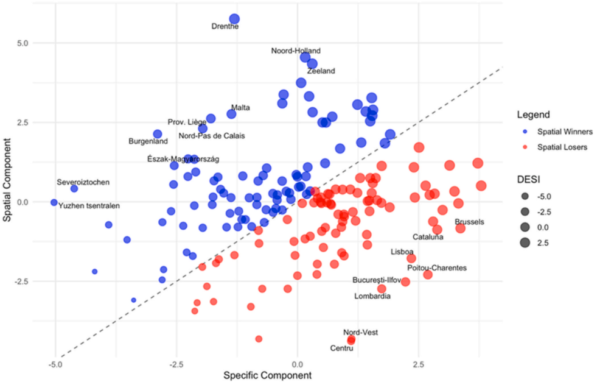
The application of this framework resulted in a regional DESI composite index that effectively captures digitalization disparities across European regions. The index highlights areas benefiting from digital spillovers and those constrained by geographic isolation. This distinction between “spatial winners” and “spatial losers” provides valuable insights into the regional digital landscape, enabling policymakers to identify critical areas for intervention.
By embedding spatial effects into the analysis, the researchers have provided a robust tool for assessing regional digitalization, aligning with the EU’s commitment to territorial cohesion. The findings underscore the importance of considering spatial dimensions in digitalization studies, offering a more nuanced understanding of regional disparities.
Policy Implications and Future Directions
This research has significant implications for policy development, offering a strategic tool for addressing digital divides and informing targeted interventions. Identifying spatial winners and losers enables more effective resource allocation and policy design, supporting the EU’s digitalization goals. As digital technologies evolve, the framework developed in this study provides a foundation for future research and policy initiatives aimed at fostering balanced digital development across Europe.
The authors have made a valuable contribution to digitalization studies, inviting further exploration and collaboration. Researchers and policymakers interested in regional digitalization are encouraged to engage with this approach and consider its application in other contexts.
Reference: Simone Mazzaferro, Alfredo Cartone, Paolo Postiglione, Andrea D’Isidoro. “Assessing regional digitalization in Europe: A spatial composite index approach.” Socio-Economic Planning Sciences 105 (2026) 102485. DOI: https://doi.org/10.1016/j.seps.2026.102485