
A new machine learning framework enhances urban flood forecasting by combining high-fidelity models with sparse sensor data. It optimizes sensor placement and uses Vision Transformer technology to improve prediction accuracy and efficiency, offering a robust solution for strengthening urban flood resilience.
Understanding the Urban Flood Challenge
Urban flooding, driven by extreme precipitation, poses a significant threat to cities worldwide. As urban areas continue to grow and climate change intensifies, the frequency and severity of these floods are expected to increase dramatically. This escalating risk necessitates accurate and timely inundation predictions to mitigate damage and safeguard communities. Traditional urban flood forecasting systems rely on high-fidelity physics-based models to simulate complex interactions between topography, infrastructure, and stormwater systems. However, these models face challenges in operational adoption due to their computational intensity and the need for ensemble simulations to account for uncertainties.
The complexity of urban environments demands models that can accurately simulate flood connectivity and response patterns, especially under diverse spatiotemporal rainfall scenarios. Despite advancements in computing technologies, the computational burden of high-resolution hydrodynamic simulations often exceeds the timespans of real floods, rendering them impractical for real-time forecasting. Moreover, the accuracy of flood predictions is hindered by uncertainties in input data, such as topography and stormwater systems, and the lack of comprehensive observational data for real-time inundation maps.
Data assimilation techniques, although standard in weather forecasting, are underutilized in urban flood contexts due to the scarcity of observational data. The deployment of sensor and camera systems offers a low-cost solution for real-time flood monitoring, but optimal sensor placement remains a challenge. Previous studies have focused on socio-economic factors for sensor installation, yet few have addressed the construction of inundation maps for large urban areas using sparse sensor data. This gap highlights the need for innovative approaches to enhance urban flood forecasting systems, ensuring they are both computationally efficient and accurate.
Innovative Framework and Methodology
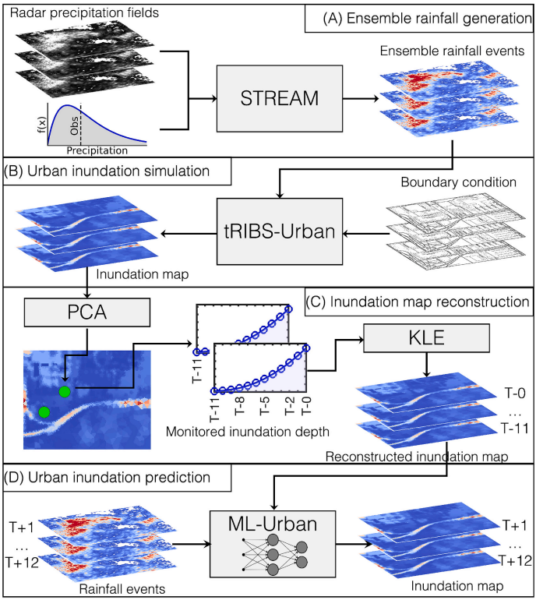
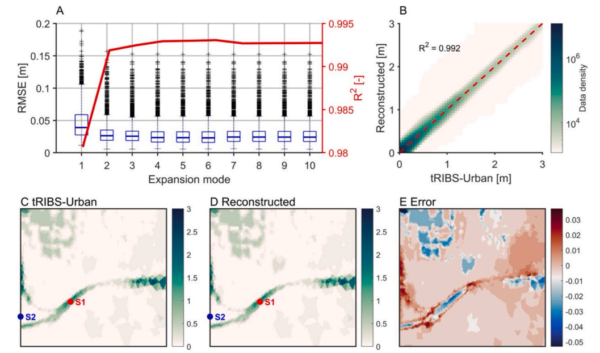
The study introduces a novel framework that integrates machine learning with high-fidelity flood modeling to advance real-time urban inundation prediction. The researchers employ a method that optimizes the placement of flood sensors to reconstruct high-resolution inundation maps using a minimal number of monitoring points. This optimization is achieved through the combination of Principal Component Analysis and Karhunen-Loève Expansion, which allows for accurate reconstruction of inundation maps from sparse observations.
A key innovation in this framework is the use of a spatio-temporal Vision Transformer (ViT) as a surrogate model for the high-fidelity flood model tRIBS-Urban. ViT, known for its superior performance in capturing long-range spatial dependencies, is particularly well-suited for modeling flood propagation across urban landscapes. By leveraging ViT, the framework can produce real-time forecasts with lead times ranging from 1 to 12 hours, achieving high accuracy with minimal cumulative error.
The framework also incorporates a stochastic rainfall model to generate diverse spatiotemporal precipitation scenarios, addressing limitations in traditional infrastructure design standards. This model provides a more realistic representation of precipitation variability, crucial for accurate flood prediction. Synthetic modeling experiments, treating high-fidelity model simulations as “synthetic inundation observations,” were conducted to evaluate the framework’s performance. This approach, widely adopted in data assimilation studies, allows for rigorous testing under controlled conditions where ground truth is known.
Key Findings and Insights
The research demonstrates that the integration of machine learning with optimized sensor placement significantly enhances urban flood forecasting capabilities. The Vision Transformer model effectively captures spatiotemporal patterns of inundation depth, achieving a Root Mean Square Error of approximately 0.15 meters and a Kling-Gupta Efficiency greater than 0.75. These results indicate high accuracy and minimal cumulative error in the forecasts.
By incorporating both rainfall and inundation observations, the framework improves prediction accuracy by 20-50% compared to models that do not consider inundation data. The successful application of this framework in synthetic experiments underscores its potential for real-world implementation, offering a robust solution for urban flood resilience.
Future Directions and Potential Impact
This innovative framework represents a significant leap forward in urban flood forecasting, providing a scalable and efficient solution for cities facing the growing threat of extreme precipitation events. The integration of machine learning with optimized sensor placement and high-fidelity modeling offers a promising pathway for enhancing flood prediction accuracy and operational efficiency.
Future research could explore the application of this framework in diverse urban settings, further refining sensor placement strategies and expanding the use of advanced machine learning architectures. The potential to reduce flood-related fatalities and economic costs underscores the importance of continued innovation in this field. We thank the authors for their valuable contribution and invite those with insights or interest in this research to engage and share their perspectives.
Reference: Vinh Ngoc Tran, G.Aaron Alexander, Xun Huan, Chen Cheng, Francina Dominguez, Brian Jewett, Kevin Gray, Jongho Kim, Daniel B. Wright, Valeriy Y. Ivanov. “Designing an inundation monitoring and real-time urban flood forecasting system: a synthetic study.” Journal of Hydrology 674 (2026) 135520. DOI: https://doi.org/10.1016/j.jhydrol.2026.135520