
Researchers have developed a fast conceptual model to predict flood arrival times after dike breaches, enhancing disaster management. This model improves evacuation strategies and response by providing rapid, accurate flood forecasts, offering a practical solution for regions with limited data availability.
Addressing the Need for Efficient Flood Modelling
Dike breaches pose significant threats globally, causing floods that endanger lives and disrupt livelihoods. Effective disaster management requires accurate insights into flood dynamics, including propagation velocity and arrival times. Traditionally, hydrodynamic models simulate these events, but their computational demands make them impractical for real-time forecasting during emergencies, particularly in large-scale flood events with uncertainties about breach locations and processes.
Surrogate models have emerged as a faster alternative, offering reasonable accuracy by simplifying system characteristics or using data-driven techniques. However, these models often fall short in simulating flood arrival times for dike breaches. Simplified conceptual models, such as the Height Above Nearest Drainage (HAND) method and Rapid Flood Spreading Methods (RFSM), struggle to accurately represent flood dynamics over time, especially in flat, low-lying delta regions.
The limitations of current models highlight the need for a new approach that can rapidly predict flood arrival times, aiding authorities in evacuation planning and disaster response. This research presents a novel conceptual model designed to address these challenges, offering a promising solution for effective flood disaster management.
Introducing a Novel Approach to Flood Arrival Time Modelling
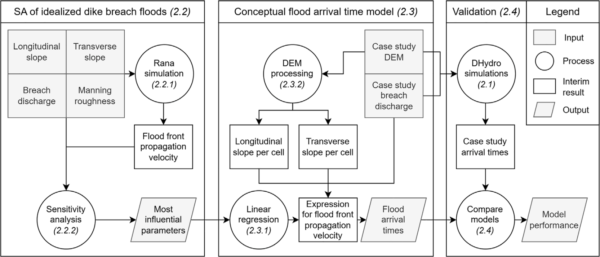
The research introduces a fast conceptual model specifically developed to simulate flood arrival times after dike breaches in flat delta regions. Unlike existing models, this approach focuses on single-inflow flood events, effectively capturing the dynamics of flood propagation through topography. The model requires only a digital elevation model (DEM) and breach discharge as inputs, making it highly applicable in data-scarce regions.
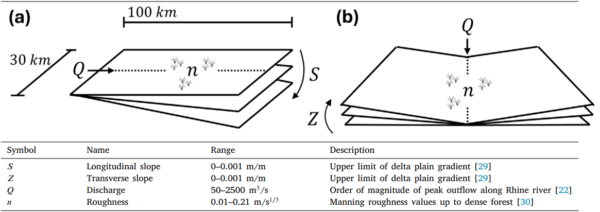
The methodology begins with a sensitivity analysis of idealized hydrodynamic simulations to identify key hinterland characteristics influencing flood propagation velocity. The analysis reveals that the slope of the hinterland in the propagation direction is crucial for determining velocity, while breach discharge is most significant near the breach itself. These insights inform the development of a linear regression equation that forms the core of the conceptual model.
The model calculates flood arrival times by applying the linear regression along the local drainage direction, determined as the steepest slope path leading away from the breach. This approach allows for rapid computation of arrival times, with the model achieving impressive accuracy in case studies of dike breaches along the Rhine river near the Dutch-German border.
Results & Conclusions: Enhancing Disaster Management
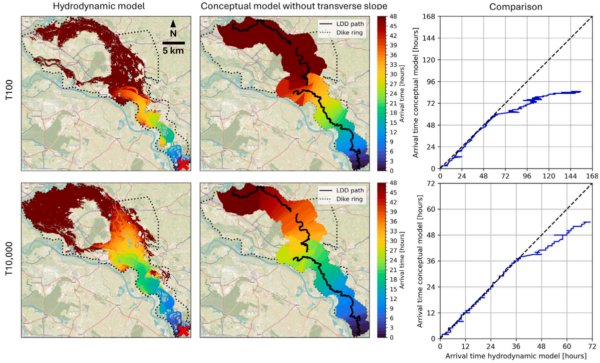
The newly developed conceptual model demonstrates remarkable accuracy in predicting flood arrival times, particularly within the first 48 hours post-breach. In case studies conducted along the Rhine river, the model achieved a mean absolute arrival time error of just 2 to 4 hours, with computation times under one second. These results highlight the model’s potential as a powerful tool for disaster preparation and response.
The research concludes that this fast conceptual model can significantly enhance flood disaster management by providing timely and accurate information on flood arrival times. This capability is vital for shaping evacuation strategies and conducting uncertainty analyses of potential breach discharge scenarios, ultimately contributing to improved public safety during flood events.
Future Directions and Impact
The implications of this research are profound, offering a new avenue for rapid flood forecasting that can be integrated into disaster management frameworks worldwide. The model’s low data requirements and swift computation make it particularly valuable for regions with limited data availability. Future research could explore further refinements to the model, potentially incorporating additional variables or expanding its application to other types of flood events.
The authors have made a significant contribution to the field of disaster science, providing a tool that could save lives and reduce the impact of flooding events. Interested parties are encouraged to engage with the research team for collaboration or to provide feedback on potential enhancements.
Reference: L.S. Besseling, A. Bomers, J.J. Warmink, S.J.M.H. Hulscher. “Fast arrival-time modelling of dike breach floods for effective disaster management.” Progress in Disaster Science, 2026. DOI: https://doi.org/10.1016/j.pdisas.2026.100565