
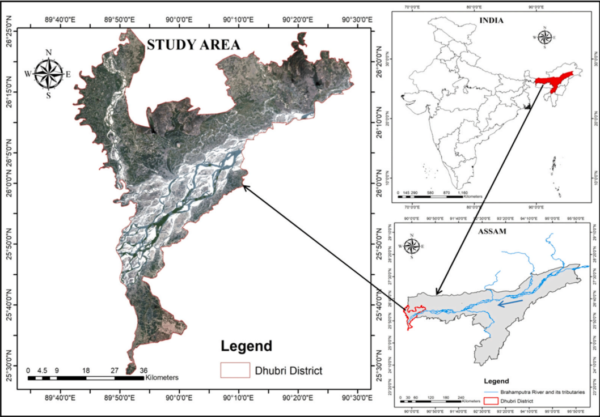
This study introduces a socio-hydrological model that examines the interaction between agriculture and demography amid recurrent monsoon flooding in the Lower Brahmaputra River Basin. It provides insights into resilience and adaptation, emphasizing the importance of feedback mechanisms in sustaining agrarian systems under flood conditions.
Monsoon Floods: A Persistent Challenge for Agrarian Communities
The Lower Brahmaputra River Basin (LBRB) in Dhubri District, Assam, India, is marked by recurrent monsoon flooding, high population density, and reliance on floodplain agriculture. The region faces severe challenges due to frequent flooding, which impacts agricultural productivity and local livelihoods. Understanding the socio-hydrological dynamics—interactions between human and water systems—is essential for developing effective adaptation strategies.
Traditional socio-hydrological models often treat agriculture as a static factor, overlooking its dynamic role in flood sensitivity, memory, and adaptation. This simplification neglects crucial interactions between agricultural productivity, demographic changes, and flood regimes, particularly in monsoon-dominated agrarian basins where livelihoods are closely tied to flood events.
The study by Marina Langhu and colleagues addresses this gap by developing a socio-hydrological model that explicitly represents flood sensitivities for both population and agriculture. The model incorporates memory-driven adaptation uptake and feedback loops between agricultural performance and demographic change, offering a nuanced understanding of how farm productivity, adaptation, and social memory coevolve with population dynamics under recurrent monsoon flooding.
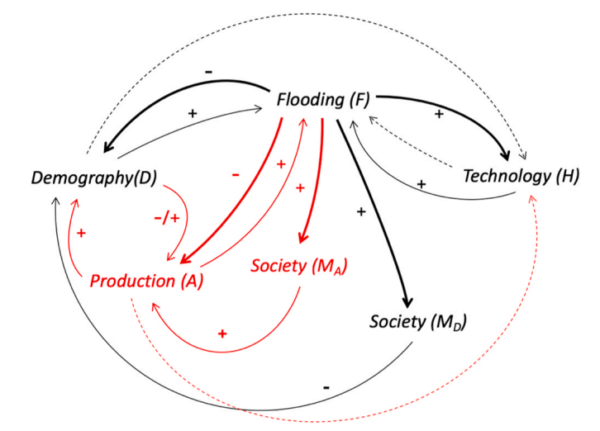
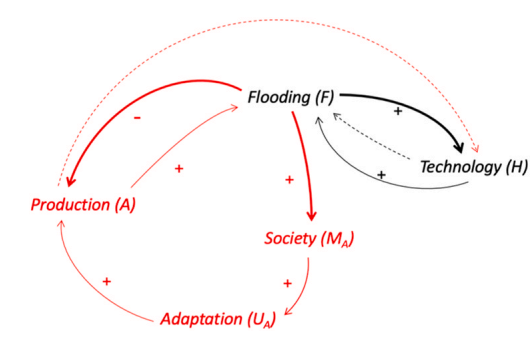
A Novel Approach: Process-Based Socio-Hydrological Modeling
The research team developed a socio-hydrological model for the LBRB, focusing on its flood-prone characteristics. The model distinguishes flood sensitivities for population and agriculture, endogenizes adaptation as a memory-driven process, and integrates feedback between agricultural performance and demographic change. Using regional data from 2003 to 2023, the model examines how adaptation, memory, and livelihood feedbacks reshape system trajectories under monsoon disturbances.
The model’s key innovation is its representation of agriculture as an active component of the human-flood system. This allows for an accurate depiction of how agricultural decisions, influenced by past hydrological events, affect adaptation behavior and demographic dynamics. The model includes memory variables that accumulate during flood years and decay during non-flood periods, reflecting the interplay between memory, adaptation, and flood impacts.
Global Sobol sensitivity analysis identified flood sensitivity parameters as primary determinants of disturbance magnitude, with intrinsic growth, memory decay, and adoption parameters contributing secondary effects. This underscores the importance of hazard intensity in flood impacts, while livelihood and behavioral feedbacks regulate recovery pathways and sustain population and agricultural persistence in flood-dependent environments.
Key Findings: Enhancing Resilience and Adaptation
The study demonstrates that activating livelihood feedbacks within the socio-hydrological model maintains higher demographic and agricultural levels despite repeated disturbances, contrasting with uncoupled dynamics that lead to accumulative flood impacts. The model provides a basis for advancing resilience assessment and adaptive management in monsoon floodplains.
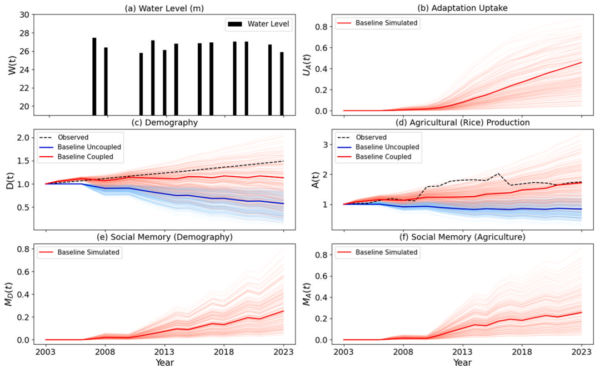
The findings highlight the importance of explicitly representing agriculture in socio-hydrological analyses of flood risk. The model captures the direct effects of flood disturbances on crop yields, farm income, and food security, influencing migration decisions, land use change, and risk perception. Hazard intensity determines disturbance magnitude, while livelihood and behavioral feedbacks regulate recovery pathways and sustain agrarian environments.
Future Directions: Advancing Socio-Hydrological Research
This research has significant implications for advancing socio-hydrological understanding and resilience assessment in monsoon floodplains. By providing a detailed process-based framework, it opens avenues for exploring complex interactions between human and water systems in flood-prone regions. Insights into memory-driven adaptation and livelihood feedbacks can inform adaptive management strategies that enhance resilience and sustainability in similar environments worldwide.
The authors’ approach sets the stage for future research to refine and expand the model, potentially incorporating additional variables and scenarios to capture the diverse dynamics of flood-dependent systems. This study invites collaboration from researchers and practitioners interested in socio-hydrological modeling and resilience building in flood-prone regions.
Reference: Marina Langhu, Masashi Kiguchi, Taikan Oki, Shinichiro Nakamura. “Coupling demography and crop dynamics under monsoon floods: A socio-hydrological case study of Dhubri, Assam, India.” Journal of Hydrology: Regional Studies 65 (2026) 103422. DOI: https://doi.org/10.1016/j.ejrh.2026.103422